
New Hire Checklist: Everything HR Needs Before, During & After Day One

Every year, companies lose roughly 17% of new hires within the first 90 days. Not because the wrong people were hired, but because the right people were handed a laptop, pointed toward a desk, and left to figure it out.
A new hire checklist doesn’t sound like the thing that would change that. It’s a humble, unexciting list. But in fifteen years of watching onboarding succeed and fail, I’ve seen a single well-built checklist do more for retention than a foosball table, a “culture deck,” and a catered lunch combined.
Here’s why: the first week at a new job is fundamentally disorienting. New employees are performing confidently while privately drowning in uncertainty: where do I park, who do I ask, am I doing this right? A checklist signals to a new hire that someone thought about them before they walked in the door. That signal matters more than most managers realize.
What is a new hire checklist?
A new-hire checklist is a structured list of tasks that HR, IT, managers, and the new employee must complete before, during, and after the employee’s first day, covering paperwork, system access, compliance requirements, benefits enrollment, and role integration.
This guide covers the full arc: pre-boarding through the 90-day mark. It’s built for HR professionals and managers who want a system that’s both legally sound and human. Skip to any section or work through it in order; either way, you’ll leave with a checklist you can actually use.
Pre-Boarding Checklist: What to Do Before Day One
Most onboarding failures are actually pre-boarding failures. The new hire shows up on Monday, and their laptop isn’t ready, their email doesn’t exist, and HR needs them to fill out three forms they could have completed from home last week. It’s a slow-motion first impression, and it’s entirely avoidable.
Pre-boarding is the window between offer acceptance and start date. Done right, it’s when your new hire goes from anxious to excited. Done wrong, it’s when they start second-guessing whether they made the right choice.
Paperwork and compliance
Get the administrative heavy lifting out of the way before day one. Send these digitally as soon as the offer is signed:
- The signed offer letter and employment agreement
- Form I-9, collect Section 1 from the employee before they start; you have 3 business days from their first day to complete Section 2
- Federal W-4 and applicable state withholding form
- Direct deposit authorization
- Emergency contact form
- Background check and drug screening consent (if required)
- Employee handbook acknowledgment
IT and systems setup
Nothing deflates a first day faster than “your access isn’t ready yet.” IT provisioning should be triggered the moment an offer is accepted, not the morning of.
| Task | Owner | Due |
|---|---|---|
| Create a company email account | IT | 1 week before start |
| Set up software licenses | IT | 3 days before start |
| Configure VPN access | IT | 3 days before start |
| Add to Slack / Teams channels | IT or HR | Day before start |
| Ship equipment (remote hires) | IT / Ops | 3–5 days before start |
The welcome experience
This one’s underrated. A short, warm welcome email sent 2–3 days before the start date does something no orientation packet can: it makes the new hire feel expected.
That email should cover first-day logistics (arrival time, who to ask for, where to park, or how to log in remotely), what to wear, what to bring, and most importantly, that someone is genuinely looking forward to their arrival. Skip the corporate tone and keep it human.
Also, before day one:
- Assign an onboarding buddy or mentor
- Set up their physical workspace or home office stipend
- Order business cards if applicable
- Brief the immediate team so introductions aren’t awkward
Related: How to Use Employee Orientation to Set New Hires Up for Success
The goal of pre-boarding is a confident delivery. When a new hire sits down on day one already knowing their login works, their team is expecting them, and their direct deposit is set up, the relationship starts from a completely different place.
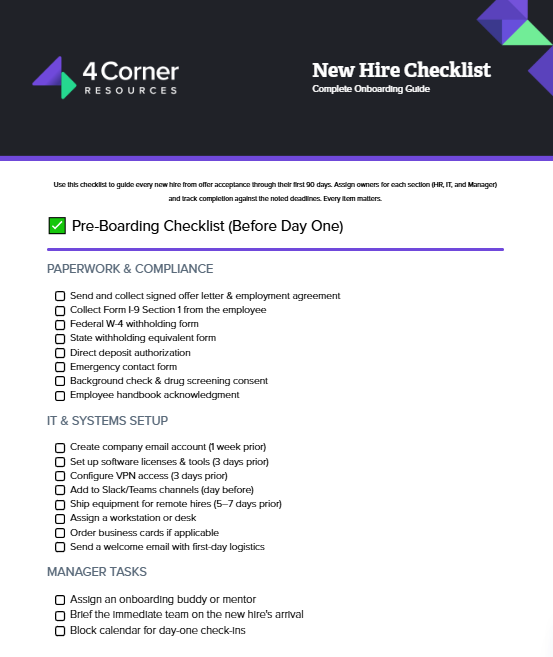
Download New Hire Checklist for Free
Day One Checklist: HR, IT & Manager Tasks
The mistake most companies make is treating day one as an information dump. Eight hours of policy walkthroughs, compliance videos, and employee handbook signatures that leave the new hire simultaneously overwhelmed and somehow still unsure what they’re actually supposed to do.
The better frame: on day one, the new hire should answer three questions that they are too nervous to ask out loud. Do I belong here? Do people want me here? Do I know what’s expected of me? Everything on this checklist serves one of those three questions.
HR tasks
- Complete Form I-9 Section 2 (must be done in person or via authorized representative; do not skip)
- Confirm all pre-boarding paperwork was received and signed
- Walk through benefits enrollment: health, dental, vision, life insurance, 401k, and clearly communicate the enrollment deadline (typically 30 days)
- Issue employee ID and access badge
- Confirm payroll is active and the first paycheck date is communicated
- Provide COBRA, FMLA, and EEO notices per federal posting requirements
IT tasks
- Confirm all logins work before the employee sits down; test them
- Walk through essential software, don’t assume familiarity
- Verify VPN, cloud storage, and any role-specific tools are accessible
- Provide IT contact information for troubleshooting
Manager tasks
This is where most day-one checklists go thin, and where the most damage gets done.
Introductions first. Before anything else, walk the new hire around and introduce them to the team, not as a formality, but as a genuine handoff. “This is who we are, and you’re one of us now.” For remote teams, a video welcome call with cameras on accomplishes the same thing.
Then cover:
- Office or virtual tour (where things live, written and unwritten norms)
- Review the job description together, not as a document but as a conversation
- Set explicit expectations for the first 30 days: what does success look like, what should they be learning, who should they be meeting?
- Schedule recurring one-on-ones starting week two
- Introduce them to their onboarding buddy if not already connected
One thing most managers forget
Block your own calendar. A manager who disappears into meetings all day on their new hire’s first day sends a message they almost certainly don’t intend. Even 30 minutes of genuine, unhurried attention at the start and end of day one is worth more than any orientation packet.
By the end of day one, your new hire should know where they stand, who to go to, and what the next two weeks look like. If they’re leaving any of those three uncertain, that’s a checklist gap, and it’s worth fixing now rather than at the 90-day review.
Related: Is Your Top Talent Having a Knockout First Day of Work? Here’s How!
First Week Checklist: Training, Tools & Team Integration
The adrenaline of day one wears off fast. By Wednesday of week one, the new hire is no longer performing confidently; they’re genuinely trying to find their footing. This is the week that separates onboarding programs that work from onboarding programs that merely exist.
The research backs this up: employees who experience structured onboarding in their first week are 69% more likely to stay with the company for three years. The structure doesn’t need to be rigid, just intentional.
Think of week one as three parallel tracks running simultaneously: compliance, capability, and connection. Miss any one of them, and you’ll feel it at the 60-day mark.
Compliance track, get the legal boxes checked without making it feel like a legal exercise:
Complete all mandatory training requirements before the end of week one. This includes OSHA safety and hazard communication training, acknowledgment of the anti-harassment and discrimination policy, any role-specific certifications or security clearances, and code of conduct sign-off. These aren’t optional, and if an audit ever happens, dated completion records are what protect you.
Capability track, set them up to actually do the job:
- Confirm all software tools are not just accessible but also understood
- Assign the first real (if small) project or task, something with a clear output. Busy work erodes confidence; purposeful work builds it.
- Share the org chart with context, not just names and titles, but a brief note on who they’ll work with most and why
- Walk through team workflows, communication norms, and where institutional knowledge lives (wikis, shared drives, Slack channels)
- Schedule role-specific training sessions if applicable
Connection track, the one most checklists skip entirely:
By Friday of week one, your new hire should have had a one-on-one conversation with at least five people outside their immediate team. Not formal meetings; coffee chats, 20-minute Zooms, and a lunch. Cross-functional relationships formed in week one become the informal network that makes someone effective six months later.
Ready to hire someone great?
Speak with our recruiting professionals today.
The Friday check-in
End week one with a deliberate, low-stakes conversation between the manager and the new hire. Not a performance review, a genuine temperature check. Three questions are enough:
- What’s made sense so far?
- What’s still confusing?
- Is there anything you need that you don’t have yet?
The answers will tell you more about your onboarding program than any survey will. And the act of asking, of demonstrating that their experience matters, is itself part of the onboarding.
By the end of week one, the new hire should have their tools working, their compliance training complete, a small early win under their belt, and the beginning of real relationships with the people around them. That’s not a high bar, but it’s a surprising number of companies that fail to clear.
Payroll & Benefits Checklist: The Details That Can’t Wait
Payroll errors are the fastest way to destroy trust with a new employee. It doesn’t matter how warm the welcome was or how smooth day one felt; if someone’s first paycheck is wrong, or late, or missing entirely, you’ve created a problem that takes months to emotionally repair. Money is personal, so getting it right is non-negotiable.
Benefits are equally high-stakes, but in a slower, quieter way. The new hire who misses their enrollment window because nobody explained the deadline doesn’t complain loudly. They just carry quiet resentment and eventually leave for somewhere that feels more organized.
Here’s what needs to happen, in roughly the order it needs to happen.
Federal and state tax setup
- W-4 (Federal Withholding) — must be collected before the first paycheck is issued. No exceptions.
- State withholding equivalent — varies by state; confirm your state’s specific form and deadline
- State new hire reporting — federal law requires employers to report new hires to their state’s Directory of New Hires within 20 days of hire. Most states have an online portal; failing to use it incurs fines.
- Add the employee to your payroll system and verify their pay rate, pay schedule, and classification (exempt vs. non-exempt) are correctly entered before their first cycle runs
Direct deposit and compensation
- Collect voided check or bank routing and account numbers
- Confirm direct deposit is active at least one full pay cycle before the first payday; don’t assume it processes automatically
- Communicate the first paycheck date explicitly. New hires rarely ask, but they’re always counting.
- Walk through how to access pay stubs (payroll portal login, mobile app, etc.)
- Clarify the expense reimbursement process and any applicable timelines
Benefits enrollment
This is where the clock matters most. Most benefits have a 30-day enrollment window from the hire date, after which the employee must wait for open enrollment, often months away.
Cover each of the following and confirm the employee understands their deadline:
| Benefit | Typical Window | Notes |
|---|---|---|
| Health insurance | 30 days from hire | Waiving coverage requires a signed waiver |
| Dental + vision | 30 days from hire | Often separate elections |
| Life insurance | 30 days from hire | Guarantee issue period, no medical exam required |
| 401k enrollment | Varies (30–90 days) | Explain employer match and vesting schedule in plain language |
| FSA/HSA | 30 days from hire | Confirm eligibility based on health plan selection |
One thing worth doing in person or over a call rather than via email: explaining the 401k match. “We match 4% if you contribute 4%” sounds simple, but a surprising number of new hires, especially younger employees entering their first professional role, don’t fully understand what that means for their take-home pay or long-term savings. Spend five minutes on it; it’s one of the highest-value conversations HR can have.
Related: Attract Top Candidates With These In-Demand Perks and Benefits
Time off and scheduling
- Explain the PTO accrual rate and when it kicks in (some companies have a waiting period)
- Share the company holiday calendar for the current year
- Clarify sick leave policy, including carryover rules and any state-mandated minimums
- If applicable, explain FMLA eligibility; employees qualify after 12 months, but knowing it exists matters
None of this is glamorous, but the companies that handle payroll and benefits with precision and transparency in week one earn something most onboarding programs never explicitly aim for: the new hire’s confidence that the organization has its act together. That confidence compounds.
HR Compliance Checklist: The Legal Requirements You Can’t Skip
Compliance isn’t the most inspiring part of onboarding. Nobody has ever left a new-hire orientation thinking that the OSHA posting really moved them. But compliance is where the consequences of getting it wrong are measured in fines, lawsuits, and, in serious cases, federal investigations.
The good news is that most compliance requirements are straightforward once you know what they are. The bad news: “I didn’t know” has never been a successful legal defense.
Here’s what’s required, what’s often missed, and what the deadlines actually are.
The non-negotiables
Form I-9 — Employment Eligibility Verification. Every employee hired in the United States must complete Form I-9. Section 1 must be completed by the employee on or before their first day. Section 2 must be completed by the employer within 3 business days of the start date. Acceptable documents are listed on the USCIS website. Don’t accept documents not on that list, and don’t request specific documents beyond what’s required. Both are violations.
State New Hire Reporting. Federal law requires all employers to report new hires to their state’s Directory of New Hires within 20 days of hire. This feeds the National Directory of New Hires, used primarily to enforce child support orders. It’s easy, it’s online in most states, and the penalties for non-compliance are real.
Required Federal Notices. The following must be provided to every new employee, typically in the welcome packet or on the first day:
- FMLA Notice (if you have 50+ employees)
- COBRA General Notice (within 90 days of health coverage start)
- EEO / anti-discrimination policy
- FLSA payday notice (pay rate, pay schedule, pay method)
- State-specific notices vary; check your state labor department
Training requirements
Mandatory training is a documented legal protection. Complete and date-stamp these within the first week:
- OSHA safety training and hazard communication (industry-specific requirements vary)
- Anti-harassment and discrimination training — required by law in California, New York, Illinois, Connecticut, and several other states; best practice everywhere
- Code of conduct acknowledgment — signed, dated, filed in the personnel record
Personnel file setup
Every new hire should have a personnel file created on day one. At a minimum, it should contain:
- Signed offer letter
- Completed I-9 (store separately from the main personnel file; this is a USCIS requirement)
- W-4 and state withholding forms
- Signed acknowledgment of the employee handbook
- Signed acknowledgment of code of conduct and any mandatory training completion records
- Benefits enrollment elections or waiver forms
A note on I-9 storage specifically: these must be retained for 3 years from the hire date or 1 year after termination, whichever is later. Keep them in a separate binder or folder, accessible for audit. An ICE audit with disorganized I-9 records is an experience worth avoiding.
What gets missed most often
In practice, the compliance gaps that show up most frequently aren’t the big ones; most HR teams know about I-9 and W-4. The gaps tend to be:
- State new hire reporting filed late or not at all
- COBRA notice sent after the 90-day window
- Anti-harassment training completed but not documented with a signed acknowledgment
- Personnel files that contain I-9s (they shouldn’t)
Build a compliance sub-checklist into your standard onboarding workflow with hard deadlines and assigned owners. Compliance fails because it gets assumed rather than assigned.
Remote Employee Onboarding Checklist: When Day One Happens Through a Screen
Onboarding a remote employee is onboarding in hard mode. Every friction point that exists in an office, the awkward hallway introduction, the “let me show you where things are,” the lunch invitation that makes someone feel included, has to be deliberately engineered when the new hire is sitting alone in a home office three states away.
Companies that treat remote onboarding as a stripped-down version of in-person onboarding consistently struggle with early remote attrition. Those that treat it as a different discipline entirely, with its own logic, rituals, and checkpoints, retain remote employees at rates that rival those of their in-office counterparts.
The difference usually comes down to one thing: intentionality. Everything that happens organically in an office has to be designed when it’s remote.
Before the start date
The equipment situation is make-or-break. A remote employee whose laptop arrives the day they start, or worse, the day after, loses their entire first week to logistics.
- Ship equipment 5–7 business days before the start date, laptop, monitors, peripherals, headset, and anything role-specific
- Include a printed setup guide in the box (not everyone will find the IT email in an unfamiliar inbox)
- Send login credentials and VPN setup instructions 2 days before start, give them time to troubleshoot before day one
- Pre-configure the device where possible so the new hire isn’t spending their first morning installing software
- Confirm the home office stipend process if your company offers one
The remote I-9 problem
Form I-9 requires in-person document inspection, which creates a genuine logistical challenge for fully remote employees. Your options:
- Use an authorized representative (any person 18 or older) to inspect documents on the employer’s behalf; the employee can use a notary, a family member, or a trusted contact
- If you use E-Verify, there are remote examination procedures available
- Some states have specific rules; verify yours before defaulting to a workaround
Document your process. If you’re ever audited, “We had a remote I-9 procedure” needs supporting documentation.
Day one, remote edition
The video welcome call is the office tour equivalent, and it deserves the same care. A few things that make it land:
Cameras on. This isn’t negotiable on day one. Text-based introductions on the first day are a missed opportunity to make a human connection.
Keep it small first. Introduce the new hire to their immediate team before throwing them into an all-hands. Belonging is built in small groups, not large ones.
Assign the first day’s agenda in writing. Remote employees don’t have the ambient cues of an office to orient themselves; they can’t see that everyone’s in a meeting until 10 am or that lunch is whenever. A written schedule for day one removes uncertainty and signals that their time was considered.
The remote connection infrastructure
This is what separates adequate remote onboarding from genuinely good remote onboarding:
- Add to all relevant Slack channels before day one, not as a task for them to do, but done for them
- Assign a remote onboarding buddy whose explicit job is to be the person the new hire can ask anything without feeling like they’re bothering someone
- Schedule 20-minute virtual coffee chats with 4–5 colleagues across the first two weeks, put them on the calendar, don’t just suggest them
- Create a shared document with “things you’d learn by osmosis in an office” team norms, communication preferences, how decisions get made, unwritten rules
The loneliness window
There’s a period in most remote onboarding, usually between weeks two and four, when the novelty has worn off, the structured check-ins have tapered off, and the new hire hasn’t yet built the informal relationships that make a job feel like more than a job. Call it the loneliness window.
The fix is simple but requires calendar commitment: manager check-ins shouldn’t taper off after week one. Keep them weekly through the 60-day mark. The signal it sends, that you matter enough for my time, is exactly what a remote employee needs when the rest of their workday happens in silence.
Remote onboarding, when done well, is just more deliberate. The companies winning at remote retention are simply refusing to let proximity be a prerequisite for belonging.
Related: How to Conduct Virtual Onboarding
The 30-60-90 Day Onboarding Plan: Building Momentum After Week One
Most onboarding checklists end where the real work begins. The forms are signed, the equipment works, the new hire knows where the bathrooms are, and then the structured support quietly evaporates. What fills that vacuum is usually a combination of sink-or-swim independence and the new hire’s own anxiety about whether they’re performing well enough.
The 30-60-90-day plan exists to prevent that vacuum. It’s not a performance review, and it’s not a probationary framework dressed up in friendlier language. It’s a roadmap, a shared agreement between the manager and the new hire about what the first three months are actually for.
The distinction matters. A new hire operating without a roadmap spends cognitive energy guessing what success looks like. A new hire with a clear 30-60-90 plan spends that same energy actually achieving it.
Day 30: learn
The first 30 days should be explicitly framed as a learning period, not a proving period. This framing does something important: it gives the new hire psychological permission to ask questions, make small mistakes, and absorb information without the pressure of needing to immediately justify their salary.
What should be true by day 30:
- All compliance training completed and documented
- Core tools and systems navigated independently
- Key stakeholders met, and relationships were initiated
- Role expectations are understood and documented in writing
- First one-on-one review completed, not to evaluate, but to check in
The day-30 conversation should answer the following: what has landed well, what’s still unclear, and whether anything is getting in the way. Keep it conversational; the goal is information, not assessment.
Day 60: contribute
By day 60, the learning wheels should be coming off. The new hire should be producing real work, participating in team decisions, and beginning to develop their own point of view on how things are done, including, occasionally, suggesting how they might be done better.
This is also when early retention risk shows up. If a new hire is disengaged at day 60, it’s rarely because of something that happened at day 60. It’s because of something that happened in week one or two that never got addressed. The day-60 check-in is your diagnostic:
- Does the role match what was described during the hiring process?
- Are the relationships with the team developing?
- Are there tools, access, or information gaps still unresolved?
- Is the new hire clear on their performance goals going forward?
Document the answers; not for the file, for the follow-through.
Day 90: perform
The 90-day mark is where onboarding formally ends and ongoing employment begins. By this point, the new hire should be operating with reasonable independence, have established working relationships across the team, and have a clear picture of what the next quarter looks like for them professionally.
The day-90 conversation is the most important of the three:
- Review the goals set at day 30; were they met, and if not, why not?
- Set formal performance objectives for the next 90 days
- Ask directly: what would make you more effective in this role?
- Send a brief onboarding satisfaction survey, anonymized if possible, to capture feedback on the onboarding process itself
That last step is the one most companies skip, which is why most companies run the same flawed onboarding program year after year. The new hire at 90 days is the only person who has just lived your onboarding experience with fresh eyes. Their feedback is the most useful data you’ll ever collect on the process.
Related: Tips for Conducting Successful Employee Performance Reviews
A note on SMART goals
The 30-60-90 framework only works if the goals inside it are specific. “Get up to speed” is not a 30-day goal. “Complete all product training modules and be able to demo the core features independently by day 30” is. The difference in outcomes between those two phrasings is not subtle.
Each milestone should have goals that are Specific, Measurable, Achievable, Relevant, and Time-bound, and they should be written down and shared with the new hire on or before day one, not retroactively constructed when the check-in arrives.
The 30-60-90 plan is ultimately an act of respect. It says: we’ve thought about your growth, not just your compliance. We have a picture of what success looks like for you, and we’re going to help you get there. That message, delivered consistently over three months, is what turns a new hire into a committed employee.
Final Thoughts: Payrolling and Hiring Support, Without the Overhead
A checklist is only as powerful as the people behind it. Everything in this guide assumes one thing: that someone owns it. At a growing company, someone is usually already wearing four other hats.
That’s where we come in.
We’ve spent years helping businesses hire smarter and onboard better, placing the right candidates and making sure they stick. And for companies that need more than a great hire, our payrolling services handle the rest: payroll processing, tax withholding and filing, benefits administration, and compliance documentation. No missed deadlines or paperwork that slips through the cracks. Just accurate, on-time payroll for every person on your team, from day one.
When you’re ready to build a team without the administrative weight that comes with every new hire, we’re ready to help.
The best onboarding experience isn’t the one you built from scratch the night before someone’s first day. It’s the one that was already waiting for them.
Get in touch with our team today to learn more.
Frequently Asked Questions
A complete new hire checklist covers five core areas: pre-boarding paperwork (I-9, W-4, direct deposit), IT and systems setup, day-one orientation tasks, benefits enrollment, and compliance training. Beyond the administrative basics, it should include manager-owned tasks such as setting 30-60-90-day goals and scheduling early check-ins. The best checklists assign every task an owner and a deadline.
Effective onboarding takes at least 90 days. Most companies make the mistake of treating it as a one-week event. Research consistently shows that structured onboarding programs extending through the first 90 days significantly improve retention and time-to-productivity. Day one handles logistics. The first week builds foundations. The first three months are when a new hire becomes a genuine contributor.
At a minimum, every new hire in the U.S. must complete Form I-9 (employment eligibility verification), a federal W-4 (tax withholding), and their state’s equivalent withholding form. Most employers also require a direct deposit authorization, an emergency contact form, an acknowledgment of the employee handbook, and benefit enrollment elections. Some roles require additional documentation, such as confidentiality agreements or role-specific certifications.
Employees must complete Section 1 of Form I-9 on or before their first day of work. Employers must complete Section 2 within three business days of the employee’s start date. For remote employees, an authorized representative can inspect documents on the employer’s behalf. I-9s must be retained for three years from the hire date or one year after termination, whichever is later.
Orientation is a single event, typically day one or week one, that covers basic logistics, introductions, and paperwork. Onboarding is the broader process that surrounds it, spanning weeks or months, and focuses on integrating the new hire into their role, team, and company culture. Orientation is a component of onboarding, not a synonym for it. Companies that confuse the two typically underinvest in everything that happens after week one.
Remote onboarding requires everything that in-person onboarding requires, plus deliberate engineering of the things that happen organically in an office. Ship equipment 5–7 days before the start date, send credentials in advance, schedule a video welcome call with cameras on, assign a remote buddy, and pre-populate the new hire’s calendar with coffee chats and check-ins. The biggest remote onboarding mistake is assuming digital access equals integration.
A 30-60-90 day plan is a structured roadmap that defines what a new hire should be learning, contributing, and performing at each milestone in their first three months. Day 30 focuses on learning the role and building relationships. Day 60 shifts toward active contribution. Day 90 marks the transition to full performance with formal goals set for the quarter ahead. It works best when written down and shared before the start date.
Before a new employee’s first day, HR should collect and process all required paperwork digitally, confirm payroll and direct deposit setup, coordinate IT provisioning, send a welcome email with first-day logistics, and assign an onboarding buddy. State new-hire reporting should also be completed; federal law requires it within 20 days of hire. The goal of pre-boarding is simple: no new hire should arrive on day one to discover they weren’t expected.
Get More Hiring Tips Straight to Your Inbox