
Talent Acquisition vs. Recruitment: What Is the Difference?

Here’s the uncomfortable truth most companies avoid: recruitment and talent acquisition are not the same thing, and treating them as synonyms is quietly costing organizations more than they realize. The U.S. Department of Labor estimates a bad hire costs at least 30% of that person’s first-year salary, and SHRM puts the average cost-per-hire at $4,700 for a typical role, climbing to $28,000 for executive positions. Those numbers don’t come from a broken process, but rather from using the wrong process entirely.
So what’s the actual difference? Talent acquisition is a long-term, proactive strategy built around identifying, attracting, and developing talent pipelines aligned with a business’s direction. Recruitment is a short-term, reactive process focused on filling an open vacancy as quickly and efficiently as possible. One is the architecture, the other is the repair crew. Both are necessary, but only one of them prevents you from needing the other quite so urgently.
This guide will walk you through what each function actually looks like in practice, who should own what, how to measure whether any of it is working, and most importantly, how to know which approach your business genuinely needs right now versus which one it needs to build toward.
What Is Recruitment?
Think of recruitment as the fire extinguisher of hiring. Someone leaves, a role opens, and the clock starts ticking. The mission is containment: find qualified candidates, move them through a defined process, make an offer, and close the role.
The process follows a familiar arc. A vacancy opens, a job description gets posted across job boards, applications come in, a recruiter screens CVs, interviews are scheduled, and an offer is extended. In most organizations, the recruiter’s job effectively ends the moment the new hire signs. That finality shapes everything about how recruitment operates. The incentive is speed, the metric is time-to-fill, and the definition of success is a signed contract rather than a thriving employee eighteen months later.
Recruitment is exactly the right tool when you need to backfill a well-defined role, when your industry has a healthy supply of active job seekers, or when you simply need someone in a seat within the next thirty days. The problem arises only when organizations apply the same reactive logic to roles that require something far more considered, and then wonder why the results keep disappointing them.
Related: How to Create a Recruitment Strategy Plan
What Is Talent Acquisition?
If recruitment is the fire extinguisher, talent acquisition is the sprinkler system, the smoke detector, and the fire safety training combined. It doesn’t wait for something to go wrong.
Talent acquisition is a continuous cycle built around five pillars: workforce planning, employer branding, pipeline building, candidate relationship management, and analytics. Where recruitment asks, “Who can fill this role today?” talent acquisition asks, “Who will we need in twelve months, and are we already talking to them?” It’s the difference between reactive problem-solving and genuine strategic foresight.
In practice, TA teams are recruiting even when there are no open roles. They’re nurturing relationships with passive candidates, refining the company’s employer brand, and feeding intelligence back to the business about where talent markets are tightening before leadership feels the squeeze. The WEF’s 2025 Future of Jobs Report found that 63% of employers cite skills gaps as their biggest barrier to growth. Talent acquisition exists precisely to make sure that statistic doesn’t become your problem.
One thing worth clarifying: recruitment is a subset of talent acquisition, not a synonym for it. TA is the architecture within which recruitment happens.
Related: 10 Strategic Trends in Talent Acquisition You Need to Know
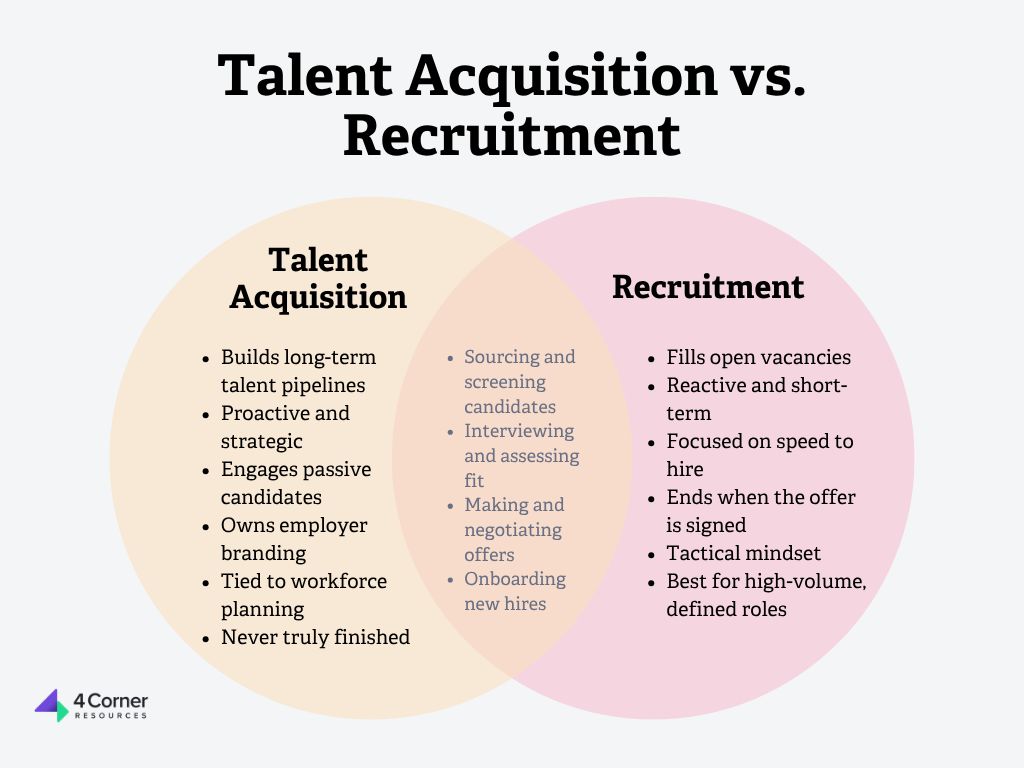
Talent Acquisition vs. Recruitment: A Direct Comparison
| Dimension | Talent Acquisition | Recruitment |
|---|---|---|
| Time horizon | Long-term | Short-term |
| Approach | Proactive | Reactive |
| Trigger | Ongoing strategy | Open vacancy |
| Focus | Quality of hire | Speed to fill |
| Candidates targeted | Active and passive candidates | Active job seekers |
| Key tools | CRM, talent intelligence, employer brand | Job boards, ATS |
| Roles targeted | Leadership, specialists, niche roles | All levels |
| Ends when… | Never — it’s a continuous cycle | Hire is made |
The distinction becomes clearest when you put both functions side by side. Eight dimensions, two very different philosophies. The table tells a clean story, but the subtext is worth naming. These aren’t competing philosophies where one wins and the other loses. Most mature organizations run recruitment inside a broader talent acquisition strategy, using the speed of one and the depth of the other, depending on what the role demands. The mistake isn’t choosing recruitment over talent acquisition; it’s failing to build the TA infrastructure in the first place and then being surprised when every senior hire feels like a scramble.
How to Decide Which Approach Your Business Needs
This is the question most hiring guides sidestep, so here it is answered directly. Read down the list and stop at the first condition that fits your situation.
If you need to fill a role within the next four to six weeks, recruitment is your tool. Don’t overcomplicate it.
If you’re hiring for a C-suite, technical, or highly specialized role, recruitment alone will likely disappoint you. The candidates you want aren’t browsing job boards. They’re already employed, probably comfortable, and need a reason to listen. That’s a talent acquisition conversation.
If your industry has chronic skills shortages in the roles you hire most frequently, you are already behind. Every day without a talent pipeline is a day your competitors are getting further ahead of you in those candidate relationships.
If you’re projecting headcount growth of 20% or more in the next twelve months, a reactive hiring model will buckle under that volume. The math simply doesn’t work without pre-built pipelines.
If you’ve made costly mis-hires at the senior level in the past two years, that’s rarely a recruiter problem. It’s a process problem, specifically the absence of the deeper candidate evaluation and relationship intelligence that talent acquisition provides.
The honest summary is this: most organizations don’t choose between recruitment and talent acquisition so much as they graduate from one to the other as they scale. Recruitment gets you started. Talent acquisition keeps you competitive.
Ready to hire someone great?
Speak with our recruiting professionals today.
Talent Acquisition Specialist vs. Recruiter: What’s the Actual Difference?
The distinction between the two matters more than most people think, because confusing the two leads organizations to hire the wrong person for the wrong mandate and then measure them against the wrong outcomes.
A recruiter’s world is defined by open requisitions. They post roles, screen applications, coordinate interviews, manage candidate communications, and work to get positions closed as efficiently as possible. Their success metrics are transactional by design: time-to-fill, cost-per-hire, and offer acceptance rate. None of that is a limitation; it’s a specialization.
A talent acquisition specialist operates on a longer clock. Their core responsibilities look like this:
- Building and maintaining talent pipelines for future roles before those roles exist
- Owning an employer brand strategy and the candidate experience that shapes it
- Proactively engaging passive candidates through networking, events, and content
- Partnering with leadership on workforce planning and skills gap analysis
- Reporting on the quality of hire, pipeline health, and diversity of the candidate slate
The clearest way to understand the difference is through their relationship with time. A recruiter is always working on what’s urgent. A TA specialist is always working on what’s next. In enterprise organizations, these roles coexist and complement each other. In smaller businesses, one person typically carries both mandates, which is precisely why understanding the distinction still matters: you need to know which hat you’re wearing at any given moment, because the mindset, the activities, and the measures of success are genuinely different.
How to Measure Success: KPIs for Recruitment vs. Talent Acquisition
Most organizations measure their hiring function with recruitment metrics even when they’re running a talent acquisition strategy. That disconnect is itself a strategic risk, because what gets measured shapes what gets prioritized, and if your TA team is being judged purely on time-to-fill, don’t be surprised when long-term pipeline work keeps getting deprioritized in favor of closing this week’s requisitions.
Recruitment KPIs are transactional and immediate by nature:
- Time-to-fill
- Cost-per-hire (SHRM benchmarks this at ~$4,700 for a typical role)
- Offer acceptance rate
- Sourcing channel effectiveness
Related: Top KPIs for Recruiters You Need to Track This Year
Talent acquisition KPIs operate on a longer time horizon and require more patience to interpret:
- Quality of hire is measured through performance ratings at six and twelve months
- Pipeline conversion rate from passive outreach to active candidate
- Employer brand sentiment tracked through Glassdoor scores and candidate NPS
- Internal mobility rate as a signal of long-term talent development health
- Diversity of candidate slate across leadership and specialist pipelines
The reason TA measurement feels harder is that it is. Its outcomes unfold over quarters and years rather than weeks, which makes it difficult to defend in budget conversations that reward short-term visibility. The organizations that get this right treat their TA metrics the same way a CFO treats a balance sheet: as a forward-looking indicator of organizational health, not just a record of what already happened.
How AI Is Changing Talent Acquisition and Recruitment in 2026
AI hasn’t reinvented hiring so much as it has dramatically accelerated the parts that were already happening, while quietly raising the stakes on the parts that machines still can’t do well.
What AI is doing for recruitment right now
On the recruitment side, the impact is immediate and visible. Screening, scheduling, initial candidate outreach, job description writing, and interview coordination: these workflows are being automated at scale, and the efficiency gains are real. What used to consume the majority of a recruiter’s week is increasingly handled before they ever open their inbox. That’s not a threat to the function; it’s a redistribution of where human attention should go.
Related: How to Use AI in Hiring While Keeping the Human Touch
What AI is doing for talent acquisition
Talent acquisition is gaining something it never had before: genuine predictive intelligence. Talent intelligence platforms now allow TA teams to forecast hiring difficulty for a role before it’s even approved, map competitor talent pools, identify emerging skills gaps, and build sourcing strategies around market data rather than instinct. For a function that has always argued it deserves a seat at the strategic table, that data layer is a powerful credential.
Related: Is the Future of Hiring in Predictive Analytics?
The number worth knowing
Our AI Threat Index puts current worker anxiety at 32.9 out of 100, and the number tells a more nuanced story than most headlines do. Only 16.1% of workers name AI as their biggest employment threat, ranking it below economic conditions, company stability, and industry shifts.
What matters more for hiring leaders is where the concern actually lives:
- 61.1% of workers would change jobs, are considering it, or have already done so, specifically for better AI exposure
- The average worker estimates 37% of their job could be done by AI, but the majority see that as augmentation rather than replacement
- AI concern is greatest among financial services, technology, and executive-level workers, precisely the candidates whose talent acquisition strategies are most focused on
Workers aren’t panicking about AI. They’re repositioning around it. For talent acquisition teams, that’s both a warning and an opportunity. Your organization’s relationship with AI is increasingly part of the employer brand conversation, whether you’re having it intentionally or not.
Recruitment Fills Seats. Talent Acquisition Builds Organizations.
The difference between companies that consistently attract great people and those that perpetually scramble rarely comes down to budget or brand. It comes down to whether hiring is treated as a reaction or a strategy. The organizations that get this right are simply the ones that stopped waiting for vacancies to force their hand.
If this guide has made you realize your organization is more reactive than it should be, that’s a useful place to land. Awareness is the first move. The second is finding the right partner.
At 4 Corner Resources, we’ve been connecting companies with exceptional talent since 2005, working across industries and at every level from high-volume recruitment to executive search. If you’re ready to stop reacting and start acquiring, we’d love to talk.
Reach out to us today to start the conversation.
Frequently Asked Questions
Not quite, though the confusion is understandable given how interchangeably the industry uses them. Recruitment is a single process with a defined start and end point. Talent acquisition is the broader strategy that encompasses recruitment, along with workforce planning, employer branding, pipeline development, and long-term candidate relationship management. Calling them the same thing is a bit like calling a single chapter the whole book.
A talent pipeline is a curated pool of candidates who have been identified, engaged, and kept warm for roles that don’t yet exist or haven’t been formally opened. It matters because the best candidates for senior and specialist roles are almost never actively looking, and the window to engage them rarely aligns with the moment you need them. Organizations with strong pipelines hire faster, spend less, and make better decisions because they’re choosing from a considered pool rather than whoever responded to a job posting in the last two weeks.
HR is the broader organizational function covering everything from compliance and compensation to culture, benefits, and employee relations. Talent acquisition sits within HR but is focused exclusively on the front end of the employee lifecycle: finding, attracting, and bringing in the right people. Think of HR as the whole engine and TA as the intake valve.
Consistently, and often more than they expect. Small businesses tend to feel every mis-hire more acutely than large enterprises because there’s less organizational cushion to absorb a poor fit. Even a basic TA approach, maintaining a short list of strong candidates from previous hiring rounds, actively managing employer reputation on review platforms, and building relationships in relevant professional communities, creates a meaningful competitive advantage when the next role opens.
The U.S. Department of Labor estimates a bad hire costs at least 30% of that employee’s first-year salary. For an $80,000 role, that’s $24,000 in direct costs before you account for lost productivity, team disruption, and the time cost of starting the search over. At the senior level, where SHRM estimates cost-per-hire can reach $28,000, the compounding effect of a wrong decision is significant enough to appear on a balance sheet.