
How to Review a Resume Effectively: A Hiring Manager’s Complete Guide

Picture this: 200 resumes hit your inbox by Tuesday morning. You have a team meeting at nine, a one-on-one at eleven, and an actual job to do in between. Somewhere in that pile is the person who will either make your next year easier or become your most expensive hiring mistake… no pressure.
Here’s the uncomfortable truth most hiring guides won’t tell you: the resume isn’t the problem. The process is. Most hiring managers were never formally taught how to review resumes; they just started doing it one day, inherited someone else’s bad habits, and kept going. The result? Great candidates get passed over because a resume didn’t look right, and weak candidates slide through because they knew the right buzzwords.
This guide fixes that. Whether you’re screening your first stack or your five hundredth, you’ll come away with a faster, sharper, more defensible process, one that finds the signal in the noise before the noise buries you.
Before You Open a Single Resume
Most hiring managers dive straight into the pile. This is the mistake. The five minutes you spend preparing before you read a single line will save you hours of second-guessing later, and more importantly, it protects you from the oldest trap in recruiting: letting the first strong resume set the bar for everything that follows.
- Start with your non-negotiables. Pull up the job description and separate the requirements into two columns: must-haves and nice-to-haves. Must-haves are the hard line. No degree? Out. No specific certification the role legally requires? Out. Everything else lives in the nice-to-have column, where nuance and potential get to breathe. This distinction sounds obvious until you’re on resume 47 and you’ve quietly started treating “preferred” as “required” because you’re tired.
- Build a simple checklist. It doesn’t need to be elaborate. Five to seven criteria drawn directly from the job description. Minimum experience, relevant skills, required education, location, or availability requirements, if applicable. The goal is consistency. When three different hiring managers review the same stack with three different mental checklists, you don’t get the best candidate, but rather the one who appealed most to whoever reviewed them last.
- Choose your sorting system and commit to it. Yes, no, maybe. Qualified, unqualified, revisit. The label doesn’t matter. What matters is that you make a fast, low-stakes first call on every resume and move on. Nothing slows a review process down faster than a hiring manager who agonizes over every middling application before they’ve even seen the full range of the pool.
Staffing your team doesn’t have to be hard.
Reach out and see how we can help.
How to Read a Resume: The 30-Second First Pass
Before you read a single word of someone’s work history, you’ve already learned something about them. The way a resume is constructed tells you how that person organizes information, communicates under constraint, and thinks about their audience. A cluttered, wall-of-text resume from a candidate applying for a project management role is its own kind of answer.
Scan the layout first
Clean formatting, logical flow, adequate white space. You’re not judging aesthetics. You’re asking whether this person made it easy for you to find what you need. Hiring managers who use an applicant tracking system should know that heavily designed resumes with columns, graphics, and custom fonts frequently break ATS parsing entirely, meaning the most visually impressive resume in your stack might be the one the system reads as gibberish.
Look for keywords
Not a word-for-word match to your job posting, but the conceptual fingerprint. If your posting emphasizes client relationship management and their resume never mentions clients, customers, accounts, or stakeholders in any form, that absence is information. Candidates who tailor their language to the role they’re applying for are showing you they pay attention.
Clock the career progression
In thirty seconds, you can see whether someone has grown, stagnated, or zigzagged. None of those trajectories is automatically good or bad. A zigzag in an industry going through disruption might be exactly the adaptability you need. What you’re looking for at this stage is a story that makes sense, even if it’s unconventional.
If the layout, keywords, and trajectory all pass the sniff test, the resume earns a deeper read. If one of them gives you pause, note it and keep moving. You can always come back. The first pass is a filter, not a verdict.
What Each Section of a Resume Actually Tells You
Most hiring guides tell you what to look at. Few explain what you’re actually reading for when you get there. Here’s how to extract the real signal from each part of the resume.
Work experience: read for impact, not inventory
The biggest mistake reviewers make is treating the experience section like a checklist. Did they manage people? Check. Did they use the software? Check. What that misses is the difference between someone who held a role and someone who drove something inside it.
Look for accomplishment language over responsibility language. “Managed social media accounts” tells you almost nothing. “Grew organic engagement 40% in six months by rebuilding the content calendar from scratch” tells you how that person thinks. When you see bullets that read like a copy-paste from a generic job description, that’s not a red flag so much as an absence of signal. Keep scanning, but note it.
Skills section: signal vs. filler
| Worth your attention | Usually filler |
|---|---|
| Specific tools, platforms, and languages | “Team player” |
| Certifications tied to the role | “Results-oriented” |
| Quantified proficiency levels | “Familiar with” |
| Industry-specific methodologies | “Strong communicator” |
Broad, vague language in a skills section often masks a shallow experience base. The candidate who lists “proficient in Salesforce, HubSpot, and Zoho with five years of CRM migration experience” is giving you something to verify. The one who lists “CRM software” is giving you homework.
Related: What to Look for on a Resume
Education: context, not criteria
Unless the role has a hard educational requirement, treat the education section as context rather than a gate. A candidate with a communications degree and eight years of relevant experience is no less qualified than one with a directly relevant degree and two years of on-the-job experience. What education tells you is trajectory, how someone has invested in their own development over time. Look for continuing education, certifications, and relevant coursework alongside the degree line. That pattern of investment often predicts performance better than the institution name does.
Cover letter: the alignment test
Not every application includes one, and not every role requires it. But when a cover letter is present, read it alongside the resume rather than after. You’re looking to see whether the story they tell about themselves maps onto the evidence on the resume. A candidate who describes themselves as a collaborative leader in their cover letter but lists every achievement in purely individual terms on their resume is showing you a gap worth exploring. Conversely, a cover letter that mirrors your job posting almost word-for-word, with no specific details about the company or role, tells you it is a spray-and-pray application. File accordingly.
How to Score a Resume Objectively
Gut instinct has its place in hiring. The problem is that gut instinct looks a lot like bias when you’re reviewing 200 resumes across three weeks with four different people involved in the process. A scoring rubric anchors judgment.
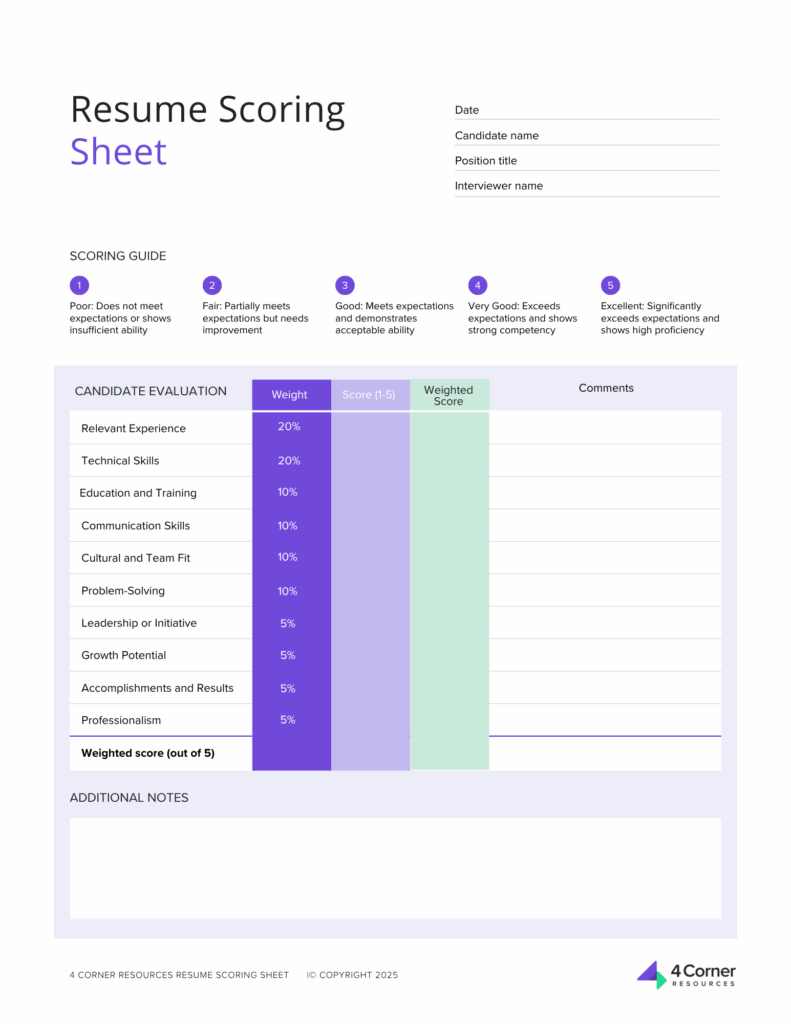
The mechanics are simple. Score each resume across seven criteria on a one-to-five scale. A five means the candidate clearly exceeds the requirement. A three means they meet it. A one means there’s a meaningful gap. Total the scores, and you have a defensible, comparable ranking that holds up whether you’re the one reviewing or handing the shortlist to someone else.
The seven criteria
1. Relevant experience: Does their work history map onto the core responsibilities of the role, not just the industry?
2. Skills match: Are the specific skills from your job description present and demonstrated, not just listed?
3. Education and certifications: Do they meet the minimum requirements? If they don’t, is the gap offset by experience?
4. Achievements and results: Are accomplishments measurable? Do they suggest this person move needles rather than maintain them?
5. Career progression: Does the trajectory show growth, increasing responsibility, or deliberate skill development over time?
6. Cultural fit and soft skills: Action-oriented language like “led,” “built,” “restructured,” or “mentored” is a proxy signal. Not perfect, but worth noting.
7. Red flags: Inconsistencies, unexplained gaps, exaggerations, or a resume that appears generic and untailored. Score this one inversely: five means no concerns, one means several.
Related: The Resume Screening Scorecard Framework Every Hiring Manager Should Use
How to use it consistently
The rubric only works if everyone touching the process uses the same version with the same definitions. Before your first review session, align with your team on what a three looks like for each criterion in the context of this specific role. What counts as sufficient relevant experience for a senior position is different from what counts for an entry-level one. Build that context into the rubric before the resumes arrive, not while you’re arguing about candidate number twelve.
One practical note: resist the urge to average scores across reviewers without first comparing them. A candidate who scores a four from one reviewer and a two from another isn’t a three. They’re a conversation worth having.
Download Resume Screening
Scorecard for Free!
Resume Red Flags: What to Watch For and How to Weigh Them
A red flag isn’t a disqualifier; it’s a question the resume hasn’t answered yet. The difference between a hiring manager who builds great teams and one who keeps reposting the same role every eight months often comes down to knowing which questions are worth asking and which answers should end the conversation.
Employment gaps: update your priors
The post-pandemic labor market has permanently changed what employment gaps mean. Layoffs, caregiving, burnout-driven sabbaticals, and industry-wide contractions have left gaps on the resumes of some of the most capable professionals in the market. A gap alone tells you almost nothing. What matters is what surrounds it. Strong tenure before and after a gap, with clear progression on either side, is a green flag wearing a yellow jacket. Flag it for a conversation, not the reject pile.
The language tells you more than the timeline
Vague, hedging language is a more reliable warning sign than any date discrepancy. Phrases like “participated in,” “assisted with,” “exposure to,” and “familiar with” are the verbal equivalent of fine print. They gesture at experience without claiming it. Used occasionally, they’re harmless. Used throughout, they suggest a candidate who is either embellishing their involvement or genuinely uncertain about their own qualifications. Neither is what you’re looking for.
Watch for three other patterns:
- Responsibilities without results. A resume full of “responsible for managing X” with no indication of what happened to X under their watch.
- Titles that don’t match the narrative. A candidate claiming senior-level impact whose actual titles suggest they were two levels below the decisions they’re describing.
- Generic resumes sent to specific roles. If nothing in the resume acknowledges the nature of your company, your industry, or your actual job posting, you are looking at a volume application. That’s not automatically disqualifying, but it does tell you something about the level of interest.
Job hopping: red flag or green flag in 2026?
Short tenures used to be a hard stop for many hiring managers. They shouldn’t be anymore, and the data backs that up. The average job tenure in the United States has been declining steadily for a decade, and in tech, marketing, and creative fields, two-year stints are increasingly the norm rather than the exception. What you’re actually trying to assess is whether this person develops, contributes, and leaves on their own terms, or cycles out of every role before they’ve finished onboarding.
Look at the arc, not the timestamps.
Related: The Top Resume Red Flags to Watch Out for When Hiring
Avoiding Bias When Reviewing Resumes
This is the section most hiring guides treat as a compliance checkbox. It isn’t. Bias in resume screening is expensive in the most literal sense. Bad hires cost organizations an estimated 30% of that employee’s first-year salary, and a significant portion of those bad hires stem not from a lack of qualified candidates but from a flawed screening process that filtered out the right people before they ever reached an interview.
The uncomfortable part is that most bias in resume review is structural.
The affinity trap
Hiring managers consistently rate candidates more favorably when they share a common background, university, previous employer, or even hobby. This is called affinity bias, and it’s particularly insidious in resume review because it masquerades as cultural fit. “I just have a good feeling about this one” is sometimes genuine intuition and sometimes pattern recognition firing on the wrong signal. The scoring rubric from the previous section exists partly for this reason. When you have a structured framework, you’re forced to articulate why a candidate scores well rather than simply feeling that they do.
The halo and horn effects
A single impressive line on a resume, a recognizable company name, a prestigious degree, can cast a glow over everything that follows. Conversely, one early red flag can color your reading of every subsequent section. Both effects are real, both are well-documented in hiring research, and both are best countered the same way: read the full resume before forming an opinion, and score each criterion independently rather than letting your overall impression drive every individual score.
Three practical moves that reduce bias without slowing you down
Standardize before you start. Agree on what good looks like for this specific role before anyone opens a resume. Criteria set in advance are harder to unconsciously reshape around a favorite candidate.
Separate the name from the file. Several ATS platforms now support blind resume review, stripping names, addresses, and graduation years from the initial screening view. If yours doesn’t, a simple find-and-replace in a copy of the document takes 30 seconds and meaningfully levels the playing field.
Audit your shortlist before you finalize it. When you have your yes pile, look at it as a group. If it is demographically uniform in ways that don’t reflect your applicant pool, that’s a signal worth sitting with before you move to interviews.
Great hiring is not only about finding the best candidate in the pile but also about making sure the pile was read fairly in the first place.
Using ATS and AI Tools to Speed Up Resume Review
Technology hasn’t replaced the human judgment required to hire well. What it has done is eliminate the part of resume review that nobody was good at anyway: manually sorting 200 applications, Ctrl-F searching for keywords one resume at a time, and trying to remember whether candidate 34 or candidate 67 had the Salesforce experience you were looking for.
Used correctly, an ATS is a pre-filter, not a decision-maker.
What an ATS actually does
An applicant tracking system ingests resumes, parses them into structured data, and surfaces candidates who match the criteria you’ve defined. The keyword matching logic most systems use is blunt by design. It looks for presence or absence, not context or quality. A candidate who writes “managed a team of eight sales representatives” may score lower than one who simply wrote “sales team management” because the system was looking for that exact phrase.
This matters for two reasons. First, qualified candidates with non-standard resume formatting or unconventional language get dropped before human eyes ever reach them. Second, candidates who have learned to game ATS keyword matching will consistently outscore candidates who haven’t, regardless of actual ability. Neither outcome serves you. Know what your system filters out and make deliberate decisions about where human review needs to start earlier in the process.
Related: Our Top 10 Applicant Tracking Systems (With Reviews & Ratings)
Where AI screening tools help and where they don’t
The newer generation of AI screening tools goes beyond keyword matching. The better platforms can assess semantic relevance, flag inconsistencies, and even surface candidates whose experience patterns match those of your highest performers in that role. For high-volume hiring, the efficiency gains are real and significant.
The risks are equally real. AI screening tools trained on historical hiring data can encode and amplify the same biases that existed in your past decisions. If your top performers in a given role have historically shared certain background characteristics, an AI trained on that data will favor candidates with those characteristics going forward, whether or not those characteristics are actually predictive of success.
Use the technology to handle volume. Keep humans in the loop for judgment. The goal is a faster process that surfaces better candidates, not an automated one that surfaces familiar ones.
Related: How to Use AI in Hiring While Keeping the Human Touch
We Can Help Your Team Review Resumes
Reviewing resumes well is a skill, and like most skills, it looks deceptively simple until you’re the one doing it under pressure with a calendar that won’t quit and a team that needed this role filled last month.
The managers who hire consistently well aren’t necessarily better judges of talent. They’re better prepared. They define their criteria before the pile arrives. They read for evidence instead of impressions. They know what a red flag actually means, not merely what it suggests. And they’ve built enough structure into their process that gut instinct is the final filter, not the only one.
If you’ve made it this far, you’re already ahead of most.
But if the honest answer is that you don’t have the bandwidth to do this the right way, that’s not a failure of effort. That’s a resourcing problem, and resourcing problems have solutions.
At 4 Corner Resources, resume screening and candidate sourcing are what we do every single day. We’ve been placing top talent since 2005, and we’ve built a process that finds the signal in the noise faster than most internal teams can clear their inbox. Whether you need a fully managed search, a vetted shortlist delivered to your door, or simply a smarter starting point for your next hire, we can help.
Because the best hire you ever make might be sitting in a pile you don’t have time to read carefully enough.
Let’s find them together. Reach out to us today to get started.
Frequently Asked Questions
Your first pass should take thirty seconds or less. That’s enough time to assess the layout, scan for keywords, and get a read on career progression. Resumes that make the yes-or-maybe pile earn a deeper read of 2 to 3 minutes. If you’re consistently spending five or more minutes on every resume before making a single cut, you haven’t defined your criteria clearly enough.
Three things above everything else: evidence that the candidate has done work meaningfully similar to what this role requires, a pattern of growth or increasing responsibility over time, and language that suggests they understand the difference between holding a job and performing one. Everything else is context.
Do your prep work before you open the first one. Define your must-haves, build your checklist, and set your sorting categories in advance. Then do a first pass on the entire stack before going deep on any individual resume. Seeing the full range of the applicant pool before committing to a shortlist consistently produces better decisions than evaluating each resume in isolation.
Specificity. The candidates who are hardest to pass over are the ones who make it easy to answer the question: what did this person actually do, and did it matter? Measurable results, tailored language, and a clear through-line from their experience to your role. Not a beautiful template or a creative format, but evidence, clearly presented.
Get More Hiring Tips Straight to Your Inbox