
Employee Onboarding: The Complete Guide for Employers

Employee onboarding is the process of integrating a new hire into your company, from the moment they accept the offer through their first several months on the job. Good onboarding covers both the logistics, from equipment and system access to first-day paperwork, and the human side: the relationships and clear expectations that let someone do their job well and want to stay. It usually runs longer than most managers assume, often a full 90 days or more, and it has a direct effect on retention and how fast a new hire becomes productive. The sections below walk through what onboarding is, the stages it moves through, a step-by-step process, the 30-60-90 framework, and the practices that separate a strong start from a shaky one.
You spent weeks finding the right person and made the offer, but the work isn’t finished yet. The first few months determine whether that hire becomes a productive, committed employee or a quiet flight risk who’s back on the job market by spring. Onboarding is where a good hire is either cemented or lost, and it’s the part of the hiring process companies most often rush.
What Is Employee Onboarding?
Employee onboarding is everything you do to bring a new hire up to speed and make them part of the team. It starts once the offer is signed and runs through the early months of the job, well past the first day.
People sometimes use “onboarding” and “orientation” interchangeably, but they aren’t the same. Orientation is a single event, usually a day or two of paperwork and policy walkthroughs. Onboarding is the longer arc that orientation sits inside: the weeks and months of training, relationship-building, and goal-setting that turn a nervous first-day hire into someone who knows how the place works and where they fit.
Done well, onboarding answers four questions for the new person: What am I supposed to do? How do we do things here? Who do I go to? And am I doing okay? Miss any one of those and the hire starts to wobble.
Related: How to Use Employee Orientation to Set New Hires Up for Success
Why Employee Onboarding Matters
The business case is simple: a strong start keeps people, and a weak one sends them looking. The Bureau of Labor Statistics reported roughly 3.2 million quits in a single month in its most recent JOLTS release, a reminder that people leave jobs constantly and that the early weeks are when a new hire is most likely to reconsider the one they just took. Most companies aren’t giving them much reason to stay: Gallup finds only 12% of employees strongly agree their organization does a great job of onboarding new hires.
The cost of losing someone in month three isn’t only the recruiting spend to replace them. It’s the ramp time you already paid for, the productivity you never got, and the drag on the team that has to cover the gap and start over with the next person. A candidate who feels lost or misled in their first weeks rarely says so. They just keep their options open.
There’s an upside case too: when a new hire feels connected to the team and can see a path to doing well, they get productive faster and are far more likely to stay past the fragile first year. Onboarding is the cheapest retention tool you have, because it works on the people you’ve already paid to hire. We see this from the staffing side constantly: the placements that last (and some of ours have stayed with the same employer for a decade) almost always started with an employer who onboarded them with care.
Related: 15 Effective Employee Retention Strategies to Keep Your Best People
Keep rising costs from getting you down with our ‘Reducing Labor Costs’ eBook.
Learn from our experts on how to streamline your hiring process.
The Stages of Employee Onboarding
Onboarding moves through several stages, and each one has a job to do.
Preboarding (offer to first day)
The stretch between a signed offer and the start date is dead time at many companies, and it’s a mistake to waste it. Preboarding fills that window with paperwork, equipment orders, system access, and welcome touches you handle before day one, so the new hire walks in ready instead of waiting. A quick note from the manager, a first-week agenda, and gear that actually works on the first morning all tell the person they made the right choice.
Related: What Is Preboarding and Why Is It Important?
The first day
The first day sets the tone, and the goal is a warm welcome and a soft landing rather than a firehose of forms. Have their workspace ready and the logins working, with someone assigned to greet them and take them to lunch. Keep the paperwork light and introduce them to the immediate team, then let them go home feeling like they belong rather than buried. A thoughtful welcome letter or first-day message goes a long way here.
The first week
Week one is about orientation to the actual work. The new hire meets the people they’ll work with, learns the tools and processes the job depends on, and then starts to see how their role connects to everyone else’s. Pair them with a buddy or mentor if you can, and remember that clear early expectations matter more than early output.
The first 90 days
The first three months are where onboarding does its real work. Training deepens and the new hire takes on live responsibilities, while regular check-ins keep minor confusion from hardening into real frustration. Most people decide how they feel about a job in this window, so it’s the last stretch you want to leave to chance.
Beyond 90 days
Onboarding tapers off rather than ends, and by the six-month mark, the new hire should be operating independently, with a clear view of their goals and path forward. A check-in near the one-year point closes the loop and catches anyone drifting before they leave.
The Employee Onboarding Process, Step by Step
Every company handles onboarding a little differently, but a solid new employee onboarding process tends to follow the same steps.
- Send the offer and start preboarding. Get paperwork, background checks, and equipment moving the moment the offer is signed.
- Prepare the workspace and access. Have the desk, accounts, tools, and logins ready before the first morning.
- Plan the first day and week. Build an agenda so the new hire isn’t left guessing what happens next.
- Handle compliance and paperwork early. Get tax forms, policies, and required documentation out of the way so they don’t hang over the first week.
- Deliver role-specific training. Teach the actual job, tools, workflows, and standards you expect.
- Make the introductions. Connect the new hire with their team, their cross-functional partners, and a go-to person for questions.
- Set clear goals. Define what success looks like at 30, 60, and 90 days so the person knows what they’re working toward.
- Check in on a schedule. Meet regularly through the first 90 days to answer questions, give feedback, and catch problems early.
- Gather feedback and adjust. Ask the new hire how onboarding is going, and use what you learn to improve it for the next person.
If you want a printable version to work from, our new hire onboarding checklist breaks these steps into a task-by-task list you can hand to a manager.
The 30-60-90 Day Onboarding Framework
The 30-60-90 framework is a simple way to structure a new hire’s first three months by setting clear goals at each mark. It maps to how people actually ramp up.
The first 30 days are for learning: absorbing the role, the team, the tools, and how the company works. The next 30 (days 30 to 60) are for contributing: the new hire starts applying what they’ve learned and takes on real work with support. The final stretch (days 60 to 90) is for owning: by day 90 the person should be performing their core responsibilities independently and thinking about how to improve their piece of the operation.
Writing goals against these three checkpoints does two things. It gives the new hire a concrete target instead of a vague “get up to speed,” and it gives the manager a schedule for spotting whether someone is on track or falling behind without having to say so. A 30-60-90 plan is just as useful to the manager who made the hire as it is to the new employee.
Ready to hire someone great?
Speak with our recruiting professionals today.
Employee Onboarding Best Practices
The gap between onboarding that works and onboarding that doesn’t usually comes down to a handful of habits.
- Start before day one. The best onboarding begins at the offer, not the start date. Preboarding prevents first-week chaos and shows the hire you’re organized and glad to have them.
- Assign an owner. Onboarding fails when everyone assumes someone else has it. Give one person, usually the manager, clear responsibility for the new hire’s first 90 days.
- Pace the information. A new hire can’t absorb the entire employee handbook, every tool, and 30 introductions on day one. Spread it out across the first weeks so it sticks.
- Pair them with a buddy. A peer mentor gives the new hire a safe person to ask the small questions they wouldn’t want to bring to their boss. It’s one of the highest-return, lowest-cost things you can do.
- Set expectations in writing. Vague expectations breed anxiety, so clear goals at 30, 60, and 90 days tell the new hire exactly what good looks like.
- Check in on purpose. Don’t wait for the new hire to raise a hand; schedule regular check-ins so problems surface while they’re still small.
- Ask for feedback and use it. The people best positioned to tell you where onboarding falls short are the ones going through it right now. Ask them, and act on what they say.
For teams hiring remote or hybrid staff, the fundamentals stay the same, but the execution changes. Our guide on virtual onboarding covers what to do differently when the new hire isn’t in the building.
Common Onboarding Mistakes to Avoid
A few missteps show up again and again, and all of them are avoidable.
Drowning a new hire in paperwork and policy on day one, with no room to breathe or connect, is the most common. Treating orientation as the whole of onboarding is another: a great first day means little if week three is a void. Leaving onboarding unowned, so it happens by default instead of by design, guarantees an uneven experience. And going silent after the first week, when the new hire has the most questions and the least confidence, is how good hires quietly decide they made a mistake.
Employee Onboarding Checklist
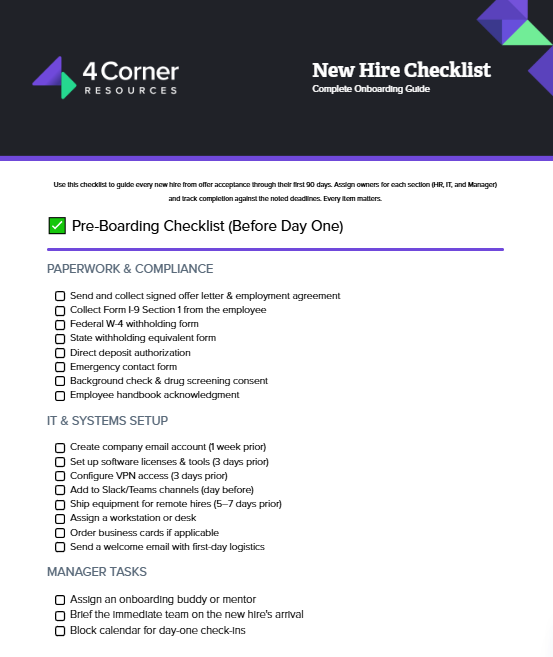
A checklist keeps onboarding from falling through the cracks when a manager is busy. At a high level, a strong onboarding checklist covers preboarding tasks (offer paperwork, equipment, access), first-day setup (workspace, introductions, agenda), first-week training and connections, and 30-60-90 goals with scheduled check-ins.
Download Our New Hire Checklist for Free
Final Thoughts
Onboarding is the last mile of a hire, and it’s the mile companies most often skip, even though you’ve already spent the money and time to find the right person. A structured first 90 days, an owner who’s accountable for it, and steady check-ins are what turn that hire into someone who stays and performs.
If the harder problem is finding the right people to onboard in the first place, that’s what we do. We place people on direct hire and contract terms, and when you bring someone on as a contractor through us, we handle much of the onboarding paperwork and payroll compliance so your team can focus on the work. Since 2005, we’ve made more than 16,750 placements and kept a 93% client return rate by matching companies with people who fit and stay. When you’re ready to hire, talk with our team.
Frequently Asked Questions
Employee onboarding is the process of integrating a new hire into your company, from the signed offer through their first several months on the job. It covers the practical setup, like equipment and paperwork, and the human side, from training and relationships to clear expectations, so the new hire can do their job well and wants to stay.
The five C’s are a framework for what good onboarding delivers: Compliance (the paperwork, policies, and legal basics), Clarification (a clear picture of the role and what’s expected), Culture (how the company actually operates), Connection (relationships with the team and key people), and Check-back (following up to see how the new hire is doing). The first four come from the widely used four C’s model; the fifth adds the follow-up step that keeps a good start from unraveling.
The 30-60-90 rule structures a new hire’s first three months around three checkpoints. The first 30 days focus on learning the role and the company, days 30 to 60 focus on contributing with support, and days 60 to 90 focus on performing core responsibilities independently. Setting goals at each mark gives the new hire a clear target and the manager a schedule for spotting problems early.
It’s longer than most people expect. A quick orientation might take a day or two, but effective onboarding runs through the first 90 days at minimum, and many companies extend it to six months or a full year. The early months are when a new hire is most likely to reconsider the job, so tapering support too soon is a common and costly mistake.
Get More Hiring Tips Straight to Your Inbox