
Candidate Evaluation Matrix: The Framework Behind Better Hiring

Hiring decisions rarely fail because of effort. They fail because of inconsistency.
I’ve sat in hundreds of debrief meetings where three smart interviewers walked away with three completely different opinions about the same candidate. One focused on personality. One fixated on a technical miss. One had a “gut feeling.” Without structure, hiring quickly becomes subjective and expensive even faster.
A candidate evaluation matrix solves that problem.
At its core, a candidate evaluation matrix is a structured scoring framework used to assess applicants against predefined competencies, weighted criteria, and measurable standards. Instead of debating impressions, hiring managers compare evidence. Instead of relying on instinct, they rely on alignment.
In 2026, structured evaluation is no longer optional. As AI tools screen resumes and skills-based hiring accelerates, the differentiator is how consistently you assess what actually matters. A clear evaluation matrix reduces bias, speeds up decisions, and protects you from costly mis-hires, especially in competitive markets where top candidates move quickly.
In this guide, you’ll learn:
- What a candidate evaluation matrix is and how it differs from a scorecard
- The essential components every hiring manager should include
- How to build a weighted matrix step by step
- A practical template you can use immediately
Hiring is too important to leave to intuition alone. The framework behind better hiring isn’t complicated, but it is intentional. Let’s build one that works.
What Is a Candidate Evaluation Matrix?
Candidate evaluation matrix definition
A candidate evaluation matrix is a structured hiring tool that scores applicants against predefined competencies using standardized criteria and weighted values. It allows hiring managers to compare candidates objectively by assigning measurable ratings to the skills, behaviors, and qualifications that matter most for the role.
In simple terms, it turns interviews into data.
Instead of asking, “Who did we like more?” you ask, “Who demonstrated the strongest evidence across our highest-priority competencies?”
A well-built matrix typically includes:
- Defined competencies tied directly to job success
- A consistent rating scale, such as 1 to 5
- Weighted categories based on role priorities
- Clear descriptions of what each score represents
The result is a side-by-side comparison grounded in evidence rather than impression.
Ready to hire someone great?
Speak with our recruiting professionals today.
Candidate evaluation matrix vs. interview scorecard
These terms are often used interchangeably, but they are not identical.
An interview scorecard typically evaluates performance within a single interview or stage. A candidate evaluation matrix aggregates scores across competencies and, often, across multiple interviewers, using weighted categories to determine the overall ranking.
Think of it this way:
- A scorecard measures performance in a moment.
- A candidate evaluation matrix measures overall fit for the role.
For hiring managers focused on structured, data-driven decisions, the matrix provides the broader framework that ties the entire interview process together.
The Benefits of Using a Candidate Evaluation Matrix
- Faster decision cycles. When competencies and weights are defined in advance, debrief conversations focus on evidence instead of opinion. This shortens the time between the final interview and the offer, which is critical in competitive markets.
- Higher quality of hire. Structured evaluation ties hiring decisions directly to role-specific success factors. Candidates are chosen based on demonstrated capability, not interview performance alone.
- Lower early turnover. When evaluation criteria reflect real performance expectations, new hires are more likely to meet them. Clear alignment at the hiring stage reduces mismatch and early attrition.
- Better documentation and defensibility. A documented scoring framework provides transparency and supports compliance. It creates a consistent record of why a candidate was selected or declined.
- Improved interviewer calibration over time. Scoring patterns reveal where criteria may need adjustment. Over time, hiring teams become sharper and more aligned.
- Reduced bias in decision-making. Anchored scoring and predefined competencies limit the influence of unconscious bias, halo effects, and “gut feel.” Independent scoring before discussion further protects objectivity and promotes fairer outcomes.
When to Use a Candidate Evaluation Matrix
- High-volume hiring. Ensures consistency across multiple openings and interviewers. Prevents criteria drift as hiring scales.
- Panel interviews. Aligns interviewers before discussions begin and provides a structured framework for comparing perspectives.
- Leadership and executive roles. Reduces risk in high-impact hires by appropriately weighting strategic thinking, influence, and long-term business impact.
- Technical or skills-based roles. Keeps measurable expertise front and center so technical competency is not overshadowed by presentation style.
- Competitive hiring markets. Speeds up decision-making by eliminating subjective debates and clarifying differences between finalists.
- Roles with compliance or documentation requirements. Provides defensible hiring documentation and supports structured, equitable evaluation practices.
Key Components of a Candidate Evaluation Matrix
A candidate evaluation matrix only works if it is built on clearly defined, role-specific criteria. The goal is precision. Each category should be directly tied to performance outcomes, not vague traits.
Core competencies
These are the technical and functional skills required to perform the job successfully.
For example:
- Software proficiency for a systems administrator
- Regulatory knowledge for a healthcare role
- Financial modeling for an analyst
Core competencies should be measurable. If you cannot describe what “strong” looks like in observable terms, the category needs refinement.
Behavioral and performance indicators
Technical skill gets someone in the door. Behavioral strength determines whether they succeed in the long term.
Focus on:
- Problem-solving under pressure
- Communication clarity
- Adaptability in ambiguous situations
- Accountability and follow-through
Avoid generic language like “good communicator.” Instead, define behaviors such as “explains complex ideas clearly to non-technical stakeholders.”
Cultural and team alignment
This category should reflect work style and operating rhythm, not personality similarity.
Examples:
- Thrives in fast-paced, unstructured environments
- Comfortable with cross-functional collaboration
- Operates independently with minimal oversight
Define alignment based on how work gets done inside your organization, not who would be “fun to work with.”
Strengthen Your Interview Strategy
Use A Hiring Manager’s Guide to Interviewing to build a consistent, effective, and fair hiring process.
How to Create a Candidate Evaluation Matrix Step By Step
A strong candidate evaluation matrix is built before interviews begin. The structure should reflect business outcomes, not resume bullet points.
Step 1: Define success for the role
Start with outcomes, not qualifications.
Ask yourself:
- What must this person accomplish in the first 90 days?
- What does strong performance look like at one year?
- What problems are we hiring this person to solve?
Tie competencies directly to measurable results. This prevents overvaluing credentials that do not translate into impact.
Step 2: Identify measurable competencies
Translate success into observable skills and behaviors.
Replace vague traits like: “Leadership.”
With measurable definitions such as: “Leads cross-functional projects with clear milestones and accountability.”
Each competency should be something an interviewer can evaluate based on evidence, not impression.
Step 3: Assign weights based on business priority
Determine which competencies drive performance most in this role.
For example:
- Revenue-generating roles may weigh results orientation and client management higher
- Technical roles may prioritize problem-solving depth and system expertise
- Leadership roles may require strategic thinking and influence
Weighting prevents overemphasis on less critical traits and keeps the evaluation aligned with impact.
Step 4: Build an anchored rating scale
Use a consistent scoring system such as 1–5.
Define each level clearly:
- 5 = Exceeds expectations with demonstrated measurable impact
- 3 = Meets expectations with solid examples
- 1 = Limited evidence or significant gaps
Anchored definitions reduce scoring inflation and ensure consistency across interviewers.
Step 5: Require independent scoring before discussion
Each interviewer should complete their scoring independently before the group debrief.
This protects against:
- Groupthink
- Halo effect
- Dominant personality influence
Discussion should clarify discrepancies, not shape initial impressions.
Step 6: Compare weighted totals and qualitative insights
Aggregate scores across categories and apply weights to calculate totals. Use this data to identify strengths, weaknesses, and meaningful gaps between candidates.
The matrix does not replace judgment. It sharpens it. It highlights where evidence supports a decision and where further discussion is needed.
Candidate Evaluation Matrix Template
A candidate evaluation matrix should be simple enough to use consistently and structured enough to produce meaningful comparisons. The best frameworks are clear, weighted, and aligned with performance outcomes.
Basic candidate evaluation matrix structure
At a minimum, your matrix should include:
- Competency category
- Weight percentage
- Rating scale (1–5 recommended)
- Candidate score
- Weighted total
Here is a simplified example:
| Competency | Weight | Candidate A | Candidate B | Weighted Score A | Weighted Score B |
|---|---|---|---|---|---|
| Technical Expertise | 40% | 4 | 5 | 1.6 | 2.0 |
| Problem Solving | 25% | 5 | 4 | 1.25 | 1.0 |
| Communication | 20% | 3 | 4 | 0.6 | 0.8 |
| Team Alignment | 15% | 4 | 3 | 0.6 | 0.45 |
| Total | 100% | — | — | 4.05 | 4.25 |
In this example, Candidate B edges out Candidate A based on weighted impact, even though both performed strongly overall. The weighting clarifies what truly matters.
Example competency definitions
To ensure consistency, define what each competency measures.
Technical Expertise: Ability to perform role-specific functions independently and accurately.
Problem Solving: Demonstrates structured thinking, root cause analysis, and applied decision-making.
Communication: Conveys ideas clearly across stakeholders with appropriate context and confidence.
Team Alignment: Works effectively within the team’s operating style and collaboration structure.
Each category should include anchored definitions for what a 1, 3, and 5 represent.
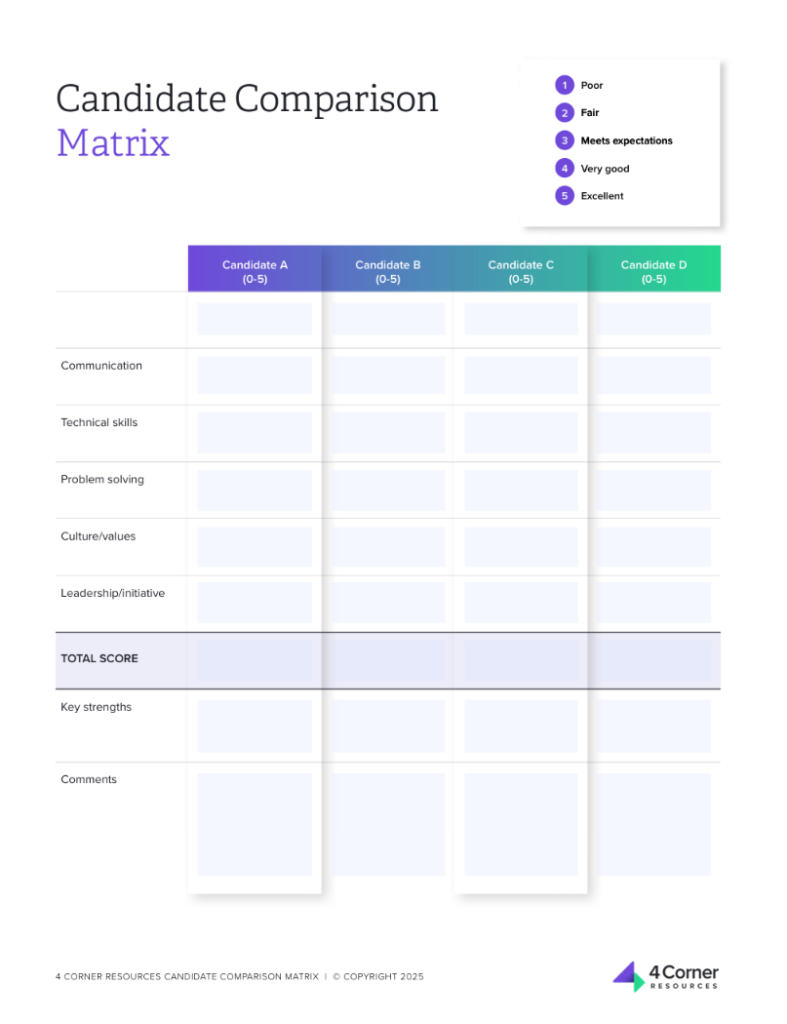
Download Our Candidate
Evaluation Matrix for Free!
When to customize your matrix
Not every role should use the same template.
- Executive roles may require heavier weighting on strategic thinking and influence
- Customer-facing roles may prioritize communication and emotional intelligence
- Technical roles may increase weight on certifications or hands-on capability
The structure remains consistent. The weighting changes based on business needs.
How to implement it immediately
To introduce a candidate evaluation matrix into your hiring process:
- Align hiring managers on competencies before interviews begin
- Share scoring criteria with all interviewers
- Require independent scoring
- Review weighted totals during debrief
- Document final rationale
The key is discipline. A matrix only improves hiring if it is used consistently.
Common Mistakes to Avoid
- Scoring after group discussion. Interviewers should complete scoring independently before the debrief. Waiting until after the discussion increases groupthink and allows dominant voices to influence ratings.
- Using vague or overlapping criteria. Categories such as “culture fit” or “leadership presence” invite subjective interpretation. Each competency should have clear, observable definitions. If categories overlap, simplify them.
- Weighting everything equally. Not all competencies drive performance equally. Equal weighting weakens business priorities and allows secondary strengths to overshadow critical requirements.
- Ignoring anchored scoring definitions. A “4” must mean the same thing across interviewers. Without defined scoring anchors, ratings become inconsistent and unreliable.
- Overriding the data without explanation. If a lower-scoring candidate is selected, document why. Repeated overrides may signal flawed weighting or poorly defined competencies.
Related: Costly Hiring Mistakes and How to Avoid Them
Final Thoughts: The Framework Behind Better Hiring
Hiring decisions shape performance, culture, and revenue. Yet most organizations still rely on loosely structured interviews and post-interview debates to decide who joins their team.
A candidate evaluation matrix changes that.
It creates alignment before interviews begin. It reduces bias. It clarifies what matters most. And it transforms subjective impressions into measurable comparisons. The result is faster decisions, stronger hires, and fewer costly resets three months later.
But building the framework is only part of the equation. The real impact comes from implementing it correctly and consistently.
At 4 Corner Resources, we do more than fill roles. We help hiring managers design smarter hiring systems. From structured interview scorecards and candidate evaluation matrices to workforce planning and market insight, our team brings decades of real-world staffing experience into every partnership. We understand where hiring processes break down because we have seen it across industries and hiring markets.
Whether you need help refining your evaluation framework, calibrating interview panels, or filling a critical role with speed and precision, we build hiring processes that are measurable, defensible, and built to scale.
If you are ready to move from reactive hiring to structured, high-performance recruiting, contact us today! We will help you design a hiring process that delivers consistent results, not just hopeful outcomes.