
We Are Hiring: Social Media Post Captions and Examples
A strong “We are hiring” social media post does four things fast: it names the role clearly, gives one real reason to care, makes applying effortless, and fits the platform it’s posted on. We’ve reviewed enough hiring posts across the clients we work with to know that most fail at step two, and that one detail costs companies the candidates they actually wanted. Job seekers decide in about a second whether to keep scrolling, so the caption has to lead with the hook and keep the company backstory brief. The best posts read like an invitation. Pick the strongest detail you’ve got, whether that’s pay, flexibility, or the team itself, and put it first. From there, writing a good caption is mostly about matching the message to the moment and the platform it lands on.
Most hiring posts go wrong in the same place. They get written like a job description that wandered onto Instagram: dense, formal, and built to inform when the goal is to attract. A job description is a document for people who’ve already decided to apply. A social post is sales copy for people who haven’t.
That difference is what most captions miss. A caption has one job: earn a few seconds of attention and make the role feel worth exploring. That takes different writing than a duties-and-requirements list.
The captions ahead are organized two ways: by situation (a single opening, multiple roles, an urgent fill, an internship) and by platform (LinkedIn, Instagram, Facebook), since the same job often needs a different pitch depending on where it lands. Find the closest match, drop in your details, and you’ve got a post ready to publish.
What Every “We Are Hiring” Social Media Post Needs
Strip away the visuals, the emojis, and the platform, and every effective hiring post comes down to the same four elements. Nail these, and the caption mostly writes itself, whatever the role.
A role that’s named clearly
Lead with the real job title, written the way a candidate would search for it. “Marketing Coordinator” is a term people type into a search bar. “Marketing Rockstar” is the kind of title that makes a strong candidate quietly wonder what the culture is hiding.
Add a line or two about what the person will do day-to-day. A couple of concrete duties let the right people lean in and the wrong people keep scrolling, helping screen some of your candidates before a single application comes in.
One real reason to care
Every job has a hundred details. A good caption picks one and leads with it. The strongest reason is usually pay, flexibility, growth, or the team itself, and your job is to name the single best one for this specific role.
The trap is reaching for words everyone uses. “Competitive salary” and “great culture” register as background noise because every employer says them. A posted range, a specific benefit, or a concrete detail about the team does the work those phrases only pretend to do. If you’re stuck on how to phrase the hook, our roundup of catchy headlines for job ads is a useful starting point.
An effortless next step
One broken link or a vague ‘apply on our website’ loses the person you just spent three paragraphs convincing. Tell them exactly what to do next, and give them a direct path to do it.
Link straight to the specific role rather than a generic careers page that makes them dig. On platforms where you can’t drop a link in the caption, say where to go (“link in bio,” “DM us your resume”) and make it obvious. Every extra step between the post and the application costs you candidates, and the good ones, who tend to have options, drop off first.
A fit for the platform
The same caption rarely works everywhere. A post that feels right on Instagram can read as try-hard on LinkedIn, and a buttoned-up LinkedIn caption can feel stiff on Facebook. Tone and format shift depending on where the post lands. Length does too. That’s a big enough topic to earn its own section, so it’s next.
How to Tailor Your “We Are Hiring” Post for Every Platform
Cross-posting the exact same caption to every platform is the fastest way to underperform on all of them. Each network has its own audience, its own rhythm, and its own idea of what normal looks like in the feed. The table below shows how a “We are hiring” post should shift across platforms.
| Platform | Tone | Ideal length | What works | Hashtags |
| Professional, still human | Long-form, a few short paragraphs | Context on the role and team, a named contact, employee reshares | 3-5 relevant, light touch | |
| Casual, visual-first | Short, 1-3 lines | A strong graphic or Reel, emojis, “link in bio” | Important for reach: mix broad and local | |
| Community, approachable | Medium | A clickable link, local job groups, “tag someone who’d be great” | Mostly decorative, skip or keep minimal | |
| X (Twitter) | Punchy, fast | Very short, a line or two | Role + hook + link, reposts for reach | 1-2 at most |
| TikTok | Authentic, creative | Short caption, the video carries it | A day-in-the-life or team clip with the role on screen | Matter for discovery: #hiring, #jobtok, plus niche tags |
The platform matters as much as the words. A senior engineering role finds more qualified eyes on LinkedIn than on TikTok. A high-volume hourly opening usually pulls better from a local Facebook group. Start where your candidates already spend time, then write for that room.
LinkedIn company page posts reach only a small slice of your followers on their own. The reach comes from people resharing it, so tag the hiring manager, ask your team to repost, and write something they’d be willing to put their name behind. We get into the mechanics of that in our guide to using LinkedIn to source top candidates.
You don’t need to be on all five. Two platforms your candidates use, posted well, will beat the same caption sprayed across every network you can think of. Pick your spots.
12 “We Are Hiring” Social Media Post Caption Examples
The captions below are yours to lift, adapt, and post. The first nine are sorted by situation, the last three by platform. Anywhere you see brackets, fill in your own specifics and post the one that fits best.
1. For a single open role
The everyday version, and the one you’ll reach for most. Keep it tight.
We’re hiring a [Job Title] at [Company]. You’ll [one specific thing they’ll own]. Starts at [$X], [remote/hybrid/on-site], with [one real benefit]. Sound like you? Apply here: [link]
It names the role, leads with something concrete, and gives one clear next step. Nothing to scroll past.
2. For multiple openings
Promoting several roles at once without burying any of them.
[Company] is growing, and we’ve got [number] roles open: [Role 1], [Role 2], and [Role 3]. [One line on what you’re building or why it’s a good place to land.] Find the one that fits and apply: [link]
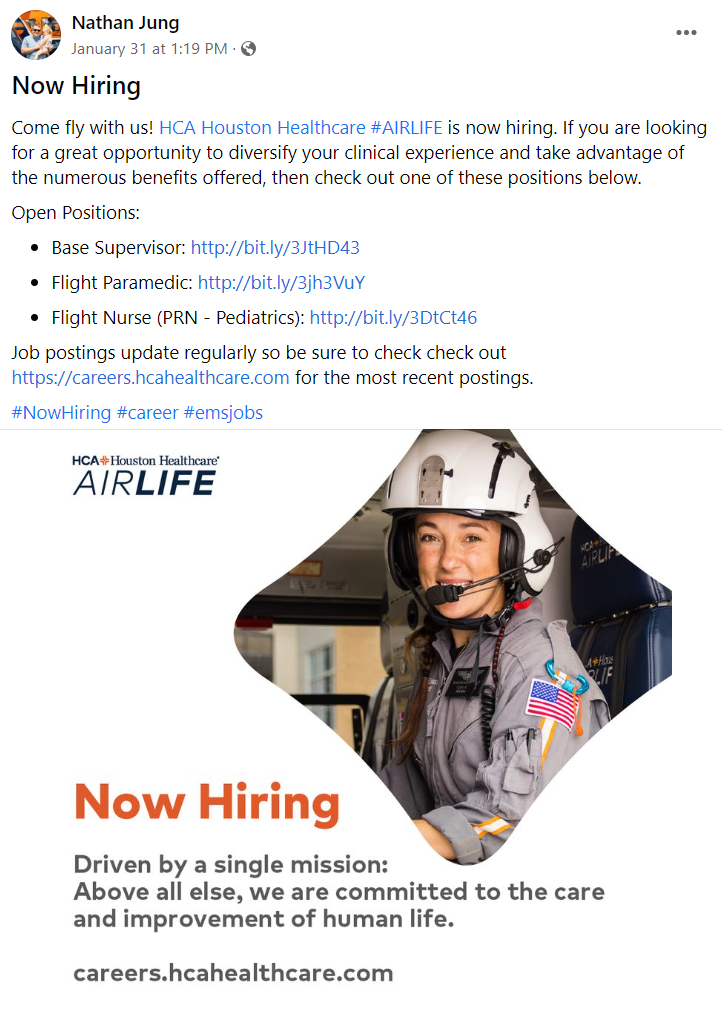
Link each role individually if you can, so nobody has to hunt for the one they want.
3. Highlighting company culture
When culture is your real advantage, show it with a specific detail. Claiming “great culture” does nothing.
What’s it actually like at [Company]? [One specific, true detail, e.g., “Friday afternoons end with a team lunch nobody has to schedule.”] We’re hiring a [Job Title] to join it. If that sounds like your kind of place, come build with us: [link]
A concrete detail does what the phrase “great culture” never could.
4. Showcasing benefits
When the package is your strongest card, lead with it and be specific.
[Role] wanted at [Company]. The headline: [specific benefit, e.g., “4-day work weeks, full health coverage from day one, and a base starting at [$X].”] The work’s good too, but we’ll let the package speak first. Apply: [link]

Not sure your range will turn heads? Our salary data can help you benchmark it before you post.
5. Employee testimonial format
The most believable pitch comes from someone already on the team.
“[First name] here, [role] at [Company]. I joined [time ago] for [reason], and I’ve stayed for [reason]. We’re looking for a [Job Title] right now, and if you want [specific thing the role offers], I’d say go for it.” Apply: [link]
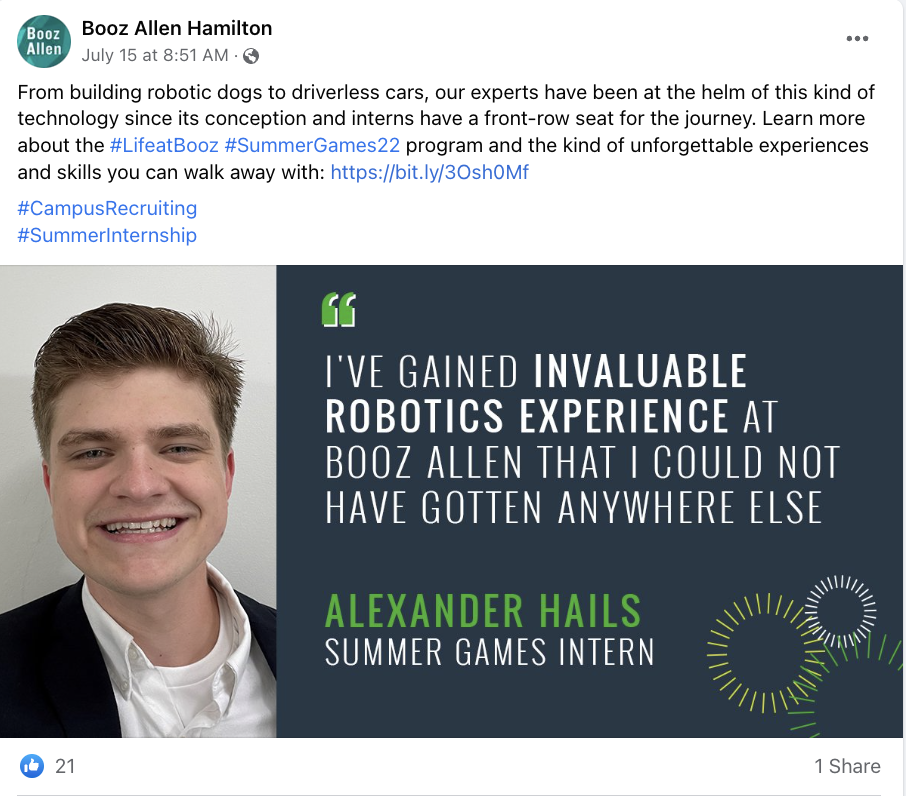
A 20-second clip of them saying it out loud beats the text version almost every time.
6. Award or recognition angle
Earned some recognition lately? Let it do the bragging for you.
[Company] was just named [award, e.g., “a Best Place to Work in [City]”]. Now we’re adding a [Job Title] to the team that earned it. [One line on the role.] Apply here: [link]
Third-party recognition carries weight that self-praise can’t, so name the award and who gave it.
7. Urgent/“We need someone fast”
Real urgency, said plainly, can actually speed things up. Faking it can’t.
Immediate opening: [Company] needs a [Job Title], and we’re moving fast. [One line on the role.] If you’re available and [key qualification], let’s talk this week. Apply now: [link]
A word of caution here. A social post is a slow tool for a fast problem, because it reaches whoever happens to be scrolling, on their schedule, not yours. When a role truly can’t wait, a staffing partner can put pre-vetted candidates in front of you in days while the post works in the background. That’s the honest version of “We need someone fast.”
Ready to hire someone great?
Speak with our recruiting professionals today.
8. Remote/hybrid role
Flexibility is one of the biggest draws going, so if you offer it, make it the headline.
Work-from-anywhere [Job Title] role at [Company]. [Fully remote, or: hybrid, X days in [City]]. [One line on the role or team.] Apply: [link]
Spell out the actual arrangement: fully remote, hybrid, the time zones you cover. The word “flexible” with no specifics makes candidates assume the worst.
9. Entry-level or internship
Talking to people at the start of their careers means lowering the intimidation, not the standards.
Just graduated? Looking for your first shot in [field]? [Company] is hiring a [Job Title]. We hire for [trait, e.g., curiosity and follow-through], and we’ll teach you the rest. You’ll learn [specific skill] from people who actually like teaching. Apply here: [link]
The intimidation factor is what stops strong entry-level candidates from hitting apply. Naming it directly is what gets them past it.
10. LinkedIn long-form caption
Built for LinkedIn’s longer, more personal format, where context and a human voice outperform a polished brand blurb.
We’re hiring a [Job Title] at [Company]. I’ve led this team for [time], so let me tell you what the role is really like.
You’ll [1-2 real responsibilities], working alongside [short, true description of the team]. The last person in this seat [grew into/shipped/built something specific], and there’s room for you to do the same.
What we need: [2-3 must-haves in plain language]. Where we’re flexible: [a common requirement you’ll bend on for the right person].
If that sounds like you, or someone you know, the application’s right here: [link]. Questions before you apply? Drop them in the comments or send me a DM.
#Hiring #[Role] #[City]Jobs
Post this from a personal profile when you can, not only the company page. The reshares are where LinkedIn reach comes from.
11. Instagram short caption
Short, visual, and designed to be read in under two seconds.
✨ We’re hiring! ✨ [Job Title] wanted at [Company]. [One punchy line on the perk or the vibe.] Tap the link in our bio to apply 👀
#Hiring #NowHiring #[City]Jobs #[Industry]Jobs
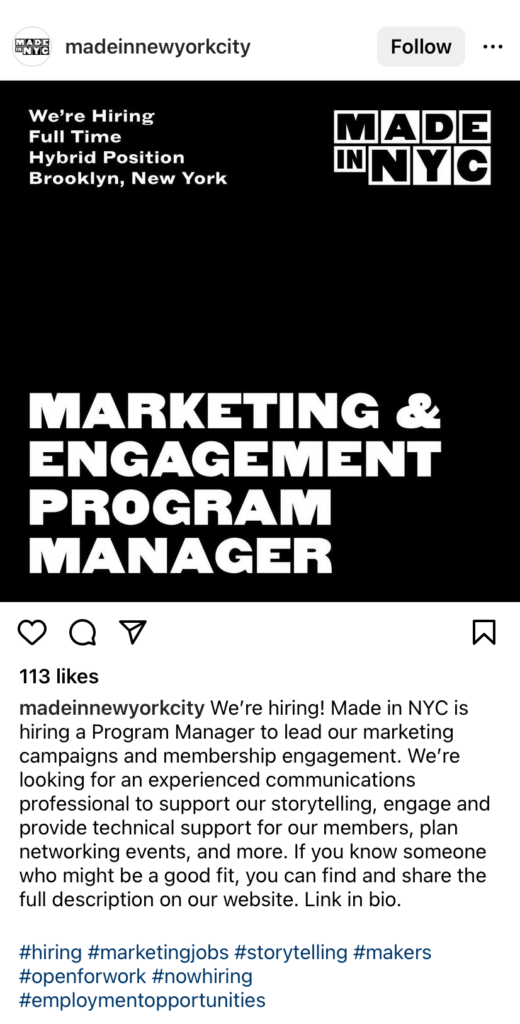
The graphic does the heavy lifting here, so put the role and one benefit in big text right on the image. The caption is the nudge, not the pitch.
12. Facebook community tone
Warm, local, and built for sharing. Facebook’s strength is community reach.
Hey [City]! 👋 We’re growing the team at [Company], and we’re hiring a [Job Title]. [One or two friendly lines on the role and why it’s a good spot to land.] Know someone who’d be perfect? Tag them below. Want it for yourself? Everything you need is right here: [link]
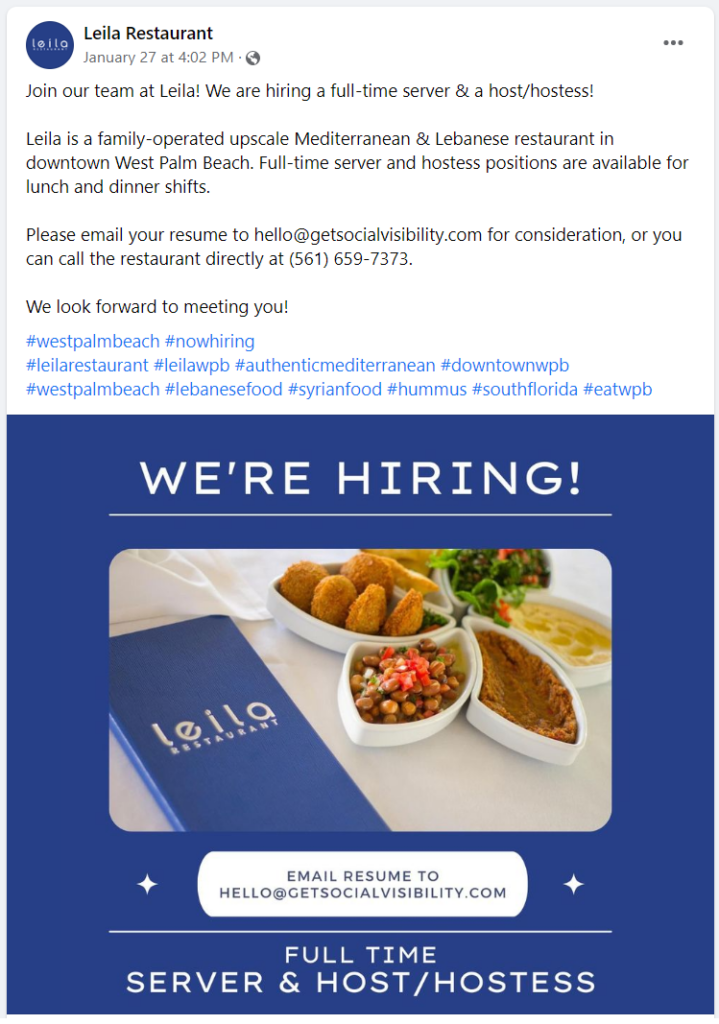
Drop this in relevant local job and community groups, not only on your page. That’s where Facebook hiring reach lives. Skip the hashtags too, since they do little here.
What Kills a Hiring Post (Common Mistakes)
Most hiring posts that go nowhere share the same few flaws, and the fixes are usually one-line changes. These five come up the most.
- The caption is a copy-pasted job description. Dense lists of duties and requirements read like fine print, and people scroll past fine print. Pull the two or three most appealing details out of the JD and leave the rest for the application page. If the description itself is the weak point, our guide to writing a job description that attracts candidates is worth a look.
- The actual job is buried. Posts that open with “We’re thrilled to announce another milestone…” make readers dig for the point, and most won’t. Lead with the role and the hook. Save the company victory lap for a different post, or cut it.
- There’s no signal about pay. Money is the top thing candidates weigh, so total silence on it reads as a warning sign. In our experience, postings with a salary range consistently attract more qualified applicants than those without. A posted range, a starting number, or even ‘above market for this role’ keeps people from assuming the worst. In a growing number of states, a range is now required anyway.
- The buzzwords do the opposite of what you intend. “Fast-paced environment,” “wear many hats,” “work hard, play hard,” and “rockstar” have been used so often to paper over understaffing and burnout that strong candidates now read them as red flags. Say the real thing instead. If the pace is high, name why, and name the support that comes with it.
- You post once and vanish. Reach on a single post fades within hours, and the candidates who comment or DM expect a reply. Reshare it, have your team repost it, and answer the people who raise their hands. A post you abandon is a post that quietly dies.
Hashtags That Actually Help
Hashtags are a small lever that only help on some platforms. They drive real discovery on Instagram and TikTok, help a little on LinkedIn, and do close to nothing on Facebook and X. Put your effort where it pays, and don’t count on tags to rescue a weak post.
The tags that connect you with candidates are the narrow ones: role-specific and local. A broad tag like #hiring or #jobs drops you into a flood where your post vanishes in seconds, so use those sparingly and lean on the specific ones.
Group your tags by tier and pull from each:
- Broad tags (#Hiring, #NowHiring, #Jobs): high traffic, high noise. Use one or two so you’re in the conversation, then move on.
- Role and industry tags (#NursingJobs, #SalesJobs, #UXJobs): where qualified people look. Match them to the exact role.
- Local tags (#OrlandoJobs, #[City]Hiring): strong for any role tied to a place, and far less crowded than the national tags.
- Branded tags (#LifeAt[Company], #[Company]Careers): your own, and worth starting now. Over time they build a searchable trail of your hiring and culture posts, which feeds your employer brand.
How many to use depends on the platform. Instagram rewards a fuller set, so front-load the most relevant ones. LinkedIn does fine with three to five. On Facebook and X, you can skip them without losing anything.
Need More Than a Good Post? Let 4 Corner Resources Handle the Search
A great “We are hiring” social media post does one job well: it gets the right people to notice. That’s the start of hiring, and on its own it’s worth doing. The harder half comes after the post goes up.
A post can’t tell you which of the fifty applicants can do the work. It can’t reach the person who’d be perfect but isn’t looking and will never see your feed. And it can’t move fast when you’re a person down and covering the gap yourself. Those are the parts that decide whether you fill a role well or settle for whoever applied.
A staffing partner earns its keep here. We source the people who aren’t applying, screen the ones who are, and keep a search moving when you don’t have time to run it yourself. Since 2005, we’ve been recognized by Forbes, Business Insider, and ClearlyRated as one of the top recruiting firms in the country.
So keep posting. The captions above will make those posts better. And when you’re hiring for a role that can’t afford a maybe, tell us what you need and we’ll get to work.
Get More Hiring Tips Straight to Your Inbox