
How to Write a Resume for Your First Job (Teenager’s Guide)
A first job resume, sometimes called a teenager’s resume, is a one-page snapshot of your skills and experience, written to convince an employer you’ll show up and do good work. If it’s your first job and you don’t have any formal work history, you build the resume around what you do have: school, clubs, sports, volunteering, and informal jobs like babysitting or mowing lawns. A strong one includes your contact information, a short objective, your skills, any experience, your activities, and your education, all on a single page. This guide covers what to put on each section, with examples and a template you can copy.
Landing your first job is exciting, and a little intimidating. You’re asking someone to take a chance on you before you’ve had the chance to prove yourself at work. A good resume makes that easier for them. It shows a hiring manager, at a glance, why you’re worth an interview.
Why You Need a Resume as a Teenager
Plenty of teenagers assume resumes are just for adults. They’re not. You’ll want one to apply for part-time jobs and internships, and often for college and scholarship applications too. Getting comfortable with the document now pays off, because you’ll use some version of it for the rest of your working life.
A first paycheck buys more than money. It buys independence and a track record you can build on. Every job teaches you something, even one that has nothing to do with your dream career. A weekend shift scooping ice cream teaches you how to handle a rush and show up on time, and those are exactly the habits your next employer cares about.
How to Write a Resume for Your First Job With No Experience
This is the part that stops most first-timers: “I don’t have any experience, so what do I even put down?” You have more than you think. The trick is to look past formal jobs and pull from everything else you’ve done.
Start by listing the things you spend real time on. Working on a group project or leading a school club shows teamwork and leadership. Babysitting, tutoring a younger student, or helping at a family member’s market booth shows responsibility and the kind of follow-through that matters when people are counting on you. Volunteering, sports, a part in the school play, a summer helping a neighbor: all of it demonstrates skills an employer wants.
Once you have that raw material, translate it into the language of work. Instead of “I babysat my cousins,” write “Supervised three children under age 8, planned daily activities, and kept parents updated.” Same experience, framed the way a hiring manager reads resumes. Focus on what you did and what came of it, and keep it honest.
What to Put on a Teenager Resume
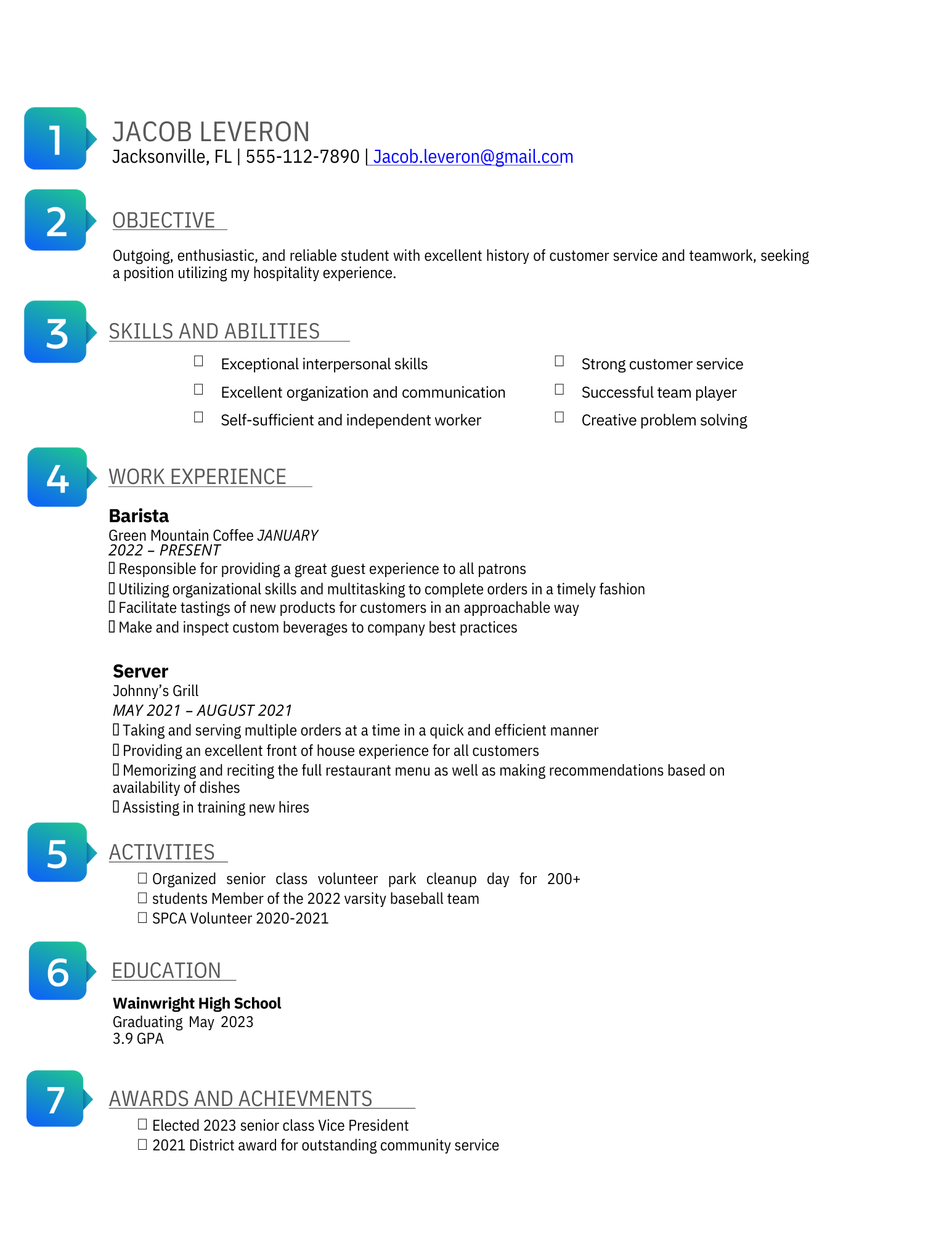
A simple, text-based, one-page format is your friend here. You don’t have a long job history to squeeze in, so a clean layout that’s easy to scan beats anything fancy. Here’s what each section should include.
- Contact information
At the top, list your name, phone number, and a professional email address. Use something close to your real name, not a nickname from middle school. A hiring manager should be able to reach you without wondering who “soccerstar_2010” is. - Objective
Write 1 or 2 sentences on who you are and what you’re looking for. Keep it specific: “Reliable high school junior seeking a part-time summer role in hospitality, with strong communication skills and open weekend availability.” A line like that tells a manager more than a generic claim about being hardworking. - Skills
Split these into 2 kinds. Hard skills are technical and teachable, like basic coding, a second language, or knowing a particular software. Soft skills are how you work, like communication, reliability, teamwork, and problem-solving. As a teen, you’ll usually have more soft skills to list, and that’s fine, because managers hiring for a first job care most about whether they can count on you.
- Experience
List any jobs here, formal or informal, most recent first. Include babysitting, tutoring, lawn care, or helping at a family business. For each one, add the role and rough dates, then 2 or 3 bullets describing what you handled, each starting with an action verb. - Activities
Give clubs, sports, and volunteer work their own section. These show character and commitment even when they aren’t paid. Note anything that shows leadership or follow-through, like a class officer role, a varsity season, or a volunteer effort with real hours behind it. - Education
List your school, your expected graduation date, and your GPA if it’s above 3.0. A hiring manager may not realize you’re still in high school unless you say so, and that context helps them read the rest of the resume. - Awards and honors
This section is optional. Use it if you have something relevant, like being elected to a leadership role, making the honor roll, or receiving district or state recognition. Skip social titles like prom court; they don’t tell an employer anything useful.
Teenager Resume Examples
Here are two short examples of how the experience section can look when you don’t have a traditional job yet.
A first retail or hospitality job
- Objective
Dependable high school sophomore seeking a part-time cashier role, available evenings and weekends. - Experience
Concession Volunteer, Lincoln High Booster Club (2025 to present)
– Served customers during high-volume game-day events
– Handled cash and made change accurately under time pressure
– Restocked supplies and kept the counter area clean
A babysitting and tutoring background
- Experience
Babysitter, neighborhood families (2024 to present)
– Cared for three children ages 2 to 9 on a weekly schedule
– Planned meals and age-appropriate activities
– Built trust with parents through clear, consistent communication
Peer Tutor, school math lab (2025)
– Helped classmates prepare for algebra tests
– Explained concepts patiently and tracked their progress
A Teenager Resume Template You Can Copy
Paste this into a document and fill in your own details.
- [Your Name] [Phone] | [Professional email] | [City, State]
- Objective [1 or 2 sentences: who you are, the role you want, and your availability.]
- Skills [4 to 8 skills, a mix of hard and soft. Example: customer service, teamwork, basic Spanish, reliability.]
- Experience [Role], [Where] ([Dates]) – [What you did, starting with an action verb] – [A result or responsibility]
- Activities – [Clubs, sports, volunteering, with any leadership or hours noted]
- Education [School Name], expected graduation [Month Year] [GPA if above 3.0]
Tips to Make Your Resume Stand Out
Keep the whole thing to a single page. A hiring manager spends seconds on a first pass, so make it easy to skim.
Lead your bullets with action verbs like served, organized, or managed, and cut filler words. Proofread it twice, then have a parent or teacher read it once more, because a single typo can undo a strong resume.
One more thing that’s changed: most first jobs now start with an online application, and many employers use software to scan resumes before a person ever sees them, which is one more reason to keep your format simple and your wording clear. Plain text and standard section headings read cleanly for both the software and the manager.
FAQs
Ready to Apply?
Once your resume is ready, the next step is finding roles that fit. If you want to sharpen the rest of your search, our guides on optimizing your LinkedIn profile and interview questions are good next reads. Your first resume won’t be your last, so get it down on paper, keep it honest, and update it as you go.
Get More Hiring Tips Straight to Your Inbox